
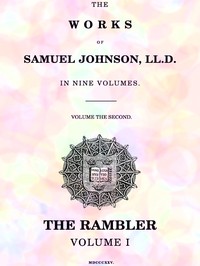
The Works of Samuel Johnson, LL.D. in Nine Volumes, Volume 02: The Rambler, Volume I
Written by Samuel Johnson
Chaptra reads alongside you — AI insights, chapter breakdowns and reader discussions for every book. Join free
About this book
Read it with a club
Chaptra's ideas and essays clubs — small groups reading the same books and talking as they go.


Books That Changed My Mind
Ideas and essays
- 5 members
- 4 discussions
- Active Sep 11
Not books you enjoyed. Books that moved you off a position you'd genuinely held for years. This is a Chaptra house club — set up and moderated by us to get the conversation going. Open to everyone; jump in anywhere.
Read The Works of Samuel Johnson, LL.D. in Nine Volumes, Volume 02: The Rambler, Volume I alongside people who are reading it too.
Chaptra Prime — paid clubs, every club feature, and unlimited reading support, for $5 a month or $60 once.
See PrimeReading guide
Themes, characters and key ideas in The Works of Samuel Johnson, LL.D. in Nine Volumes, Volume 02: The Rambler, Volume I, written by Chaptra AI.
- about 15 hours
- advanced
- Reflective
- Didactic
- Serious
Samuel Johnson's 'The Rambler, Volume I' is a seminal collection of 18th-century essays where Johnson, acting as a profound moralist, meticulously dissects human nature, vice, and societal shifts. Through a series of reflective pieces, he aims to provide moral instruction and enlightenment rather than mere entertainment. The volume's opening preface establishes Johnson's serious intent to critique and reform the evolving literary and social landscape, positioning his work as a vital mirror for self-scrutiny and wisdom. He emphasizes the writer's increased responsibility in a changing society, offering timeless observations on life and morality, making it a cornerstone of English prose and moral philosophy.
“The great object of Johnson's Rambler was to teach the world to think.”
Key themes
- Moral Instruction and Reform
- Central to Johnson's stated purpose, this theme explores the explicit role of literature in providing ethical guidance and correcting societal vices. Johnson believes writers have a profound responsibility to educate and uplift their audience, aiming to improve individual conduct and public morality rather than merely entertain. Each essay serves as a moral lesson, dissecting human actions and motivations to reveal underlying ethical principles.
- Human Nature and Folly
- Johnson's essays consistently delve into the universal aspects of human behavior, often highlighting inherent weaknesses, irrationality, self-deception, and the perpetual struggle between reason and passion. He explores the sources of human discontent, the pursuit of fleeting pleasures, the dangers of pride, and the often-elusive nature of true happiness, demonstrating a deep, if sometimes melancholic, understanding of the human condition.
- The Role of Literature and the Author
- Johnson uses 'The Rambler' not only to deliver moral lessons but also to reflect deeply on the craft of writing, the evolving literary landscape of the 18th century, and the moral obligations of authors. He discusses the shift from patronage to a broader public readership, the increasing influence of popular taste, and the imperative for writers to maintain integrity and purpose amidst these changes, advocating for literature as a force for good.
Worth discussing
Discuss Johnson's explicit purpose for 'The Rambler' as outlined in the preface. How does this align with or diverge from your own views on the purpose of literature?
Chapter-by-chapter breakdowns, character arcs and the full thematic analysis come with a free account.
Discussions
No one has started one yet
Questions this book opens up
No discussions yet
Be the first to start a discussion about this book!
Sign up to start the discussionReviews
No reviews yet
Be the first to review this book!