
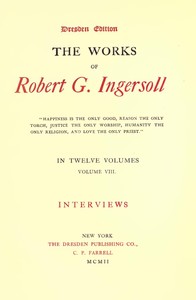
The Works of Robert G. Ingersoll, Vol. 08 (of 12): Dresden Edition—Interviews
Written by Robert Green Ingersoll
Chaptra reads alongside you — AI insights, chapter breakdowns and reader discussions for every book. Join free
About this book
Reading guide
Themes, characters and key ideas in The Works of Robert G. Ingersoll, Vol. 08 (of 12): Dresden Edition—Interviews, written by Chaptra AI.
- about 8 hours
- intermediate
- Thought-provoking
- Skeptical
- Rational
Robert G. Ingersoll's 'The Works, Vol. 08: Dresden Edition—Interviews' compiles a series of late 19th-century discussions where the prominent freethinker articulates his skeptical views on religion, particularly Christianity, and advocates for reason, intellectual freedom, and human progress. Through candid and often humorous rhetoric, Ingersoll challenges traditional religious doctrines, the concept of an afterlife, and divine authority, emphasizing humanity's role in societal advancement. The volume offers a unique window into contemporary philosophical, theological, and political debates, positioning Ingersoll as a pivotal figure in the freethought movement. It invites readers to critically examine established beliefs and embrace a rational, humanistic perspective on life and society.
“No solid evidence exists to support claims of divine authority or immortality; we must build our lives on the certainties of this world.”
Key themes
- Reason vs. Faith
- This is the foundational conflict explored throughout the interviews. Ingersoll consistently champions reason, logic, and empirical evidence as the only valid paths to truth, directly contrasting them with faith, dogma, and supernatural revelation. He argues that faith, when unsupported by reason, leads to superstition, intellectual stagnation, and moral inconsistencies, while reason fosters progress and enlightenment.
- Humanism and Progress
- Ingersoll's humanism posits that humanity itself is the source of moral values, societal improvement, and individual happiness. He rejects the idea that progress is divinely ordained or that human suffering is a test. Instead, he emphasizes that human effort, ingenuity, and compassion are the true drivers of a better world, advocating for a focus on earthly well-being rather than a promised afterlife.
- Critique of Organized Religion
- Ingersoll's interviews provide a comprehensive and often scathing critique of organized religion, particularly Christianity. He challenges the authority of the clergy, the moral teachings of the Bible, the concept of hell, and the historical actions of religious institutions. He views religious dogma as a hindrance to intellectual freedom and societal progress, often leading to intolerance, conflict, and the suppression of human potential.
Worth discussing
How do Ingersoll's arguments for human agency and progress resonate with or differ from contemporary views on societal development?
Chapter-by-chapter breakdowns, character arcs and the full thematic analysis come with a free account.
Discussions
No one has started one yet
Questions this book opens up
No discussions yet
Be the first to start a discussion about this book!
Sign up to start the discussionReviews
No reviews yet
Be the first to review this book!