
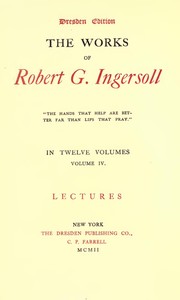
The Works of Robert G. Ingersoll, Vol. 04 (of 12): Dresden Edition—Lectures
Written by Robert Green Ingersoll
Chaptra reads alongside you — AI insights, chapter breakdowns and reader discussions for every book. Join free
About this book
Reading guide
Themes, characters and key ideas in The Works of Robert G. Ingersoll, Vol. 04 (of 12): Dresden Edition—Lectures, written by Chaptra AI.
- about 8 hours
- advanced
- intellectual
- challenging
- persuasive
Robert G. Ingersoll's 'The Works of Robert G. Ingersoll, Vol. 04' is a potent collection of late 19th-century lectures that fiercely champions skepticism, agnosticism, and the pursuit of truth through reason. The volume systematically critiques the dogmatic foundations of organized religion, emphasizing how environmental factors and upbringing often dictate belief rather than independent thought. Ingersoll challenges traditional religious narratives, particularly the concepts of a wrathful God and eternal damnation, advocating instead for intellectual freedom and a humanistic worldview. His work serves as a foundational text for the freethought movement, urging readers to question ingrained beliefs and embrace a more rational understanding of the universe.
“Most opinions are not the result of thought, but of inheritance.”
Key themes
- Skepticism and Freethought
- Ingersoll champions a rigorous skepticism, urging readers to question all inherited beliefs, particularly those presented as immutable religious truths. He advocates for 'freethought,' the idea that individuals should form their opinions based on reason and evidence, rather than blind faith or external authority. This theme is central to his entire body of work, serving as the foundation for intellectual liberation.
- Religious Criticism and Anti-Dogmatism
- This theme involves a direct and often forceful critique of organized religion's doctrines, institutions, and historical impact. Ingersoll particularly targets the dogmatic nature of faith, the concept of an anthropomorphic God, the cruelty of eternal damnation, and the emotional manipulation employed by some religious figures. He views dogma as an impediment to human progress and moral development.
- The Pursuit of Truth and Reason
- Ingersoll posits that truth is not found in ancient texts or divine revelation, but through ongoing human inquiry, scientific discovery, and the application of reason. He champions an intellectual process of constant questioning and empirical investigation, seeing it as the only path to genuine knowledge and progress. This theme is intertwined with his agnosticism, which acknowledges the limits of current human understanding.
Worth discussing
How does Ingersoll argue that environment and upbringing shape religious belief, and what are the implications of this argument for personal autonomy?
Chapter-by-chapter breakdowns, character arcs and the full thematic analysis come with a free account.
Discussions
No one has started one yet
Questions this book opens up
No discussions yet
Be the first to start a discussion about this book!
Sign up to start the discussionReviews
No reviews yet
Be the first to review this book!