
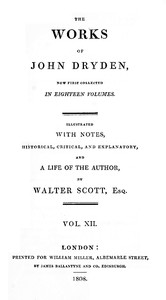
The works of John Dryden, now first collected in eighteen volumes. Volume 12
Written by John Dryden
Chaptra reads alongside you — AI insights, chapter breakdowns and reader discussions for every book. Join free
About this book
Reading guide
Themes, characters and key ideas in The works of John Dryden, now first collected in eighteen volumes. Volume 12, written by Chaptra AI.
- about 10 hours
- advanced
- epic
- romantic
- tragic
Volume 12 of 'The Works of John Dryden' is a significant collection showcasing the celebrated Restoration poet's prowess primarily as a translator and adapter of classical and medieval texts. Central to this volume is Dryden's masterful rendition of Chaucer's 'The Knight's Tale,' which vividly depicts the chivalric rivalry between Palamon and Arcite for the love of Emelie. Through rich poetic language and dramatic narrative, Dryden explores profound themes such as the arbitrary nature of fate, the complexities of human love, and the role of divine intervention. This collection not only preserves and reinterprets canonical works but also highlights Dryden's unique contribution to English literature through his eloquent and powerful verse, making ancient narratives accessible and resonant for his contemporary audience.
“For love and hate, and life and death, and fate, / Are in the hands of Jove, and subject to his state.”
Key themes
- Love and Rivalry
- This theme is central to 'The Knight's Tale,' exploring the transformative and often destructive power of love. The sudden, intense love of Palamon and Arcite for Emelie ignites a bitter rivalry, turning cousins into sworn enemies. Dryden illustrates how love can be both an ennobling force and a source of profound suffering and conflict.
- Fate vs. Free Will
- The narrative heavily emphasizes the role of destiny and divine intervention in human affairs. Despite the characters' fervent prayers and desperate actions, their lives are ultimately shaped by the decrees of the gods (Venus, Mars, Diana, Saturn). This theme questions the extent of human agency in a world governed by higher powers.
- Chivalry and Honor
- As a tale of knights, the ideals of chivalry, knighthood, and honor are paramount. The characters are bound by codes of conduct, even in their rivalry. The tournament itself is a grand display of chivalric prowess and a means to resolve conflict according to a formalized code, albeit one influenced by divine will.
Worth discussing
How does Dryden's adaptation of 'The Knight's Tale' transform or reinterpret Chaucer's original? What are the key differences in tone, style, and thematic emphasis?
Chapter-by-chapter breakdowns, character arcs and the full thematic analysis come with a free account.
Discussions
No one has started one yet
Questions this book opens up
No discussions yet
Be the first to start a discussion about this book!
Sign up to start the discussionReviews
No reviews yet
Be the first to review this book!