
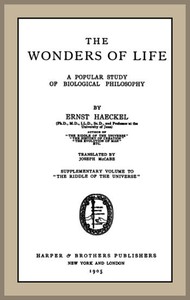
The Wonders of Life: A Popular Study of Biological Philosophy
Written by Ernst Haeckel
Chaptra reads alongside you — AI insights, chapter breakdowns and reader discussions for every book. Join free
About this book
Read it with a club
Small groups reading the same books and talking as they go.


News
- 4 members
- 1,813 discussions
- Active Sep 11
Read The Wonders of Life: A Popular Study of Biological Philosophy alongside people who are reading it too.
Also here: News Bulletin, Just Joking....
Chaptra Prime — paid clubs, every club feature, and unlimited reading support, for $5 a month or $60 once.
See PrimeReading guide
Themes, characters and key ideas in The Wonders of Life: A Popular Study of Biological Philosophy, written by Chaptra AI.
- about 12 hours
- advanced
- Philosophical
- Analytical
- Didactic
Ernst Haeckel's "The Wonders of Life" is a seminal early 20th-century work that extends his monistic philosophy, first introduced in "The Riddle of the Universe," into the realm of biological phenomena. The book systematically explores the nature of life, living organisms, and the pursuit of truth, positioning biology as the cornerstone of natural philosophy. Haeckel critiques traditional dualistic theories, arguing for a unified, monistic understanding where all existence, including consciousness and knowledge, is rooted in physiological processes. Through this lens, he provides a comprehensive framework for interpreting biological complexities and asserting the scientific basis of philosophical inquiry, aiming to popularize a holistic view of the universe.
“Truth, in its purest form, emanates from the rigorous observation of the natural world, particularly the intricate dance of life itself.”
Key themes
- Monistic Philosophy
- This is the central theme of the book, where Haeckel argues for the fundamental unity of all existence – that mind and matter, spirit and nature, are not separate entities but different manifestations of a single underlying reality. He systematically refutes dualistic theories, asserting that all phenomena, including consciousness, can be explained through natural, physiological processes.
- Nature of Life and Living Organisms
- Haeckel delves deeply into defining and understanding life, moving beyond metaphysical explanations to ground it firmly in biological and physiological processes. He explores the complexities of living organisms, their development, functions, and interconnectedness, all within his monistic framework.
- Science and Philosophy
- A core argument of the book is the inseparable relationship between science and philosophy. Haeckel advocates for a 'natural philosophy' where scientific discoveries, especially in biology, directly inform and shape philosophical understanding. He sees true philosophy as emerging from empirical science, rather than being an independent discipline, and critiques philosophical systems detached from scientific reality.
Worth discussing
How does Haeckel's monistic philosophy challenge traditional dualistic views of mind and body, and what are the implications of such a challenge?
Chapter-by-chapter breakdowns, character arcs and the full thematic analysis come with a free account.
Discussions
No one has started one yet
Questions this book opens up
No discussions yet
Be the first to start a discussion about this book!
Sign up to start the discussionReviews
No reviews yet
Be the first to review this book!