
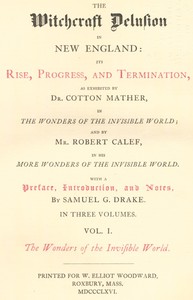
The Witchcraft Delusion in New England: Its Rise, Progress, and Termination, (Vol. 1 of 3)
Written by Cotton Mather,Robert Calef
Chaptra reads alongside you — AI insights, chapter breakdowns and reader discussions for every book. Join free
About this book
Reading guide
Themes, characters and key ideas in The Witchcraft Delusion in New England: Its Rise, Progress, and Termination, (Vol. 1 of 3), written by Chaptra AI.
- about 8 hours
- advanced
- historical
- analytical
- somber
Samuel G. Drake's 'The Witchcraft Delusion in New England' offers a pivotal 19th-century historical examination of the infamous New England witchcraft trials, meticulously tracing their origins, escalation, and eventual decline. The work critically analyzes the contributions of prominent figures like Cotton Mather, whose writings fueled the fervor, and Robert Calef, who challenged the prevailing superstitions. Drake sets the stage by depicting a society gripped by fear and credulity, exploring the profound societal impacts of these events, including widespread unjust prosecutions. Ultimately, the book serves as a crucial reflection on a dark period in American history, scrutinizing the interplay between religious belief, mass hysteria, and the uncomfortable shift towards skepticism.
“The strange and frightening atmosphere of the time, when witchcraft accusations were rampant, led to widespread fear and resulted in unjust prosecutions.”
Key themes
- Mass Hysteria and Social Psychology
- This theme explores how fear, rumor, and intense social pressure can lead to widespread irrational behavior and collective delusion within a community. Drake examines the mechanisms through which accusations spread, beliefs became contagious, and critical thinking was suppressed, leading to a breakdown of reason and justice.
- Religious Authority vs. Skepticism
- This theme highlights the intellectual and societal conflict between deeply entrenched religious dogma, which often embraced supernatural explanations, and the nascent forces of rational skepticism that challenged these beliefs. Drake uses Mather and Calef as primary examples of this struggle, showing how religious leaders could both inspire and be victims of superstition, while others pushed for reason.
- The Perversion of Justice
- Drake's analysis deeply explores how the legal system was corrupted during the trials, leading to widespread injustice. This theme examines the flawed evidentiary standards (like spectral evidence), the coercion of confessions, and the intense pressure on judges and juries, resulting in a systemic failure to uphold fairness and due process.
Worth discussing
How does Drake's 19th-century perspective shape his analysis of 17th-century events, and what are the implications for historical interpretation?
Chapter-by-chapter breakdowns, character arcs and the full thematic analysis come with a free account.
Discussions
No one has started one yet
Questions this book opens up
No discussions yet
Be the first to start a discussion about this book!
Sign up to start the discussionReviews
No reviews yet
Be the first to review this book!