
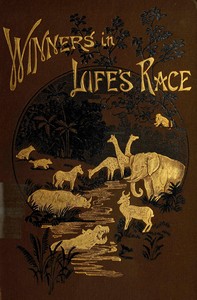
The winners in life's race : $b Or, the great backboned family
Written by Arabella B. (Arabella Burton) Buckley
Chaptra reads alongside you — AI insights, chapter breakdowns and reader discussions for every book. Join free
About this book
Reading guide
Themes, characters and key ideas in The winners in life's race : $b Or, the great backboned family, written by Chaptra AI.
- about 10 hours
- intermediate
- educational
- informative
- curious
Arabella B. Buckley's "The Winners in Life's Race: Or, the Great Backboned Family" is a foundational work of popular science from the late 19th century, meticulously exploring the evolutionary journey and adaptations of vertebrate animals. Through accessible prose, Buckley guides readers from the simplest fish to complex mammals, illustrating the principles of natural selection and the interconnectedness of life forms. The book serves as an educational bridge, making complex Darwinian concepts comprehensible to a general audience, particularly younger readers, fostering an appreciation for natural history and the wonders of the animal kingdom. It emphasizes how different species have 'won' in the 'race' of life through specialized adaptations to their environments.
“Nature, in her boundless variety, has provided each creature with the special faculties necessary to enable it to win in its own particular race.”
Key themes
- Evolution and Adaptation
- This is the central pillar of the book, explaining how species change over time through natural selection, developing specific traits (adaptations) that allow them to survive and thrive in their environments. Buckley meticulously details various adaptations across vertebrate classes, from fins and gills to wings and specialized teeth, demonstrating the ingenious ways life forms have 'won' in the 'race' for survival.
- Interconnectedness of Life
- Buckley consistently emphasizes that all vertebrates, despite their diversity, belong to a single 'great backboned family' and share common ancestry. The book highlights the intricate relationships between different species and their environments, illustrating how changes in one part of the ecosystem can affect others, and how life forms are linked through shared evolutionary history.
- The Wonder of Natural History and Scientific Observation
- Buckley's writing is imbued with a sense of awe and reverence for the complexity and beauty of the natural world. She encourages readers to engage in scientific observation, to look closely at the details of animal life, and to appreciate the intricate design and functionality of living organisms. The book acts as a guide to fostering curiosity and a scientific mindset.
Worth discussing
How does Buckley's approach to popularizing science compare to modern science communication?
Chapter-by-chapter breakdowns, character arcs and the full thematic analysis come with a free account.
Discussions
No one has started one yet
Questions this book opens up
No discussions yet
Be the first to start a discussion about this book!
Sign up to start the discussionReviews
No reviews yet
Be the first to review this book!