
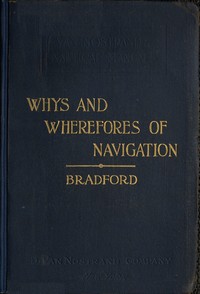
The whys and wherefores of navigation
Written by Gershom Bradford
Chaptra reads alongside you — AI insights, chapter breakdowns and reader discussions for every book. Join free
About this book
Reading guide
Themes, characters and key ideas in The whys and wherefores of navigation, written by Chaptra AI.
- about 20 hours
- advanced
- instructive
- analytical
- precise
Gershom Bradford's "The Whys and Wherefores of Navigation" is an early 20th-century scientific publication designed as an advanced instructional guide for maritime navigators. It delves into the intricate principles, practices, and underlying theories of navigation, targeting those who possess foundational knowledge but seek a deeper, more conceptual understanding. The book emphasizes the critical importance of mastering diverse directional systems, compass usage, and dead reckoning calculations amidst environmental challenges. It positions itself as essential supplementary material, aiming to provide aspiring navigators with the comprehensive 'whys and wherefores' behind the methods they routinely employ at sea.
“Effective navigation requires a thorough understanding of multiple systems, such as degrees and points of direction.”
Key themes
- Mastery through Understanding ('The Whys and Wherefores')
- Central to the book's title and purpose, this theme emphasizes that true competence in navigation stems not just from knowing *how* to perform tasks, but from a profound understanding of *why* those methods work. It advocates for intellectual curiosity and a scientific approach to practical skills, moving beyond rote memorization to deep conceptual grasp.
- Precision and Accuracy
- The book consistently highlights the critical importance of precision and accuracy in all navigational calculations, observations, and instrument usage. Errors, however small, can have significant consequences at sea, underscoring the need for meticulous attention to detail and rigorous application of methods.
- The Interplay of Theory and Practice
- Bradford's work serves as a bridge between the abstract scientific theories of astronomy, physics, and mathematics and their concrete application in the practical art of navigation. It demonstrates how theoretical knowledge directly informs and improves practical execution, making a navigator more adaptable and effective.
Worth discussing
How has the 'whys and wherefores' of navigation evolved with technological advancements (e.g., GPS, INS)?
Chapter-by-chapter breakdowns, character arcs and the full thematic analysis come with a free account.
Discussions
No one has started one yet
Questions this book opens up
No discussions yet
Be the first to start a discussion about this book!
Sign up to start the discussionReviews
No reviews yet
Be the first to review this book!