
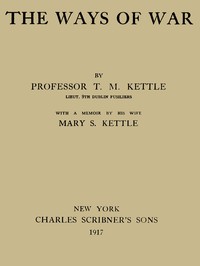
The Ways of War
Written by Tom Kettle
Chaptra reads alongside you — AI insights, chapter breakdowns and reader discussions for every book. Join free
About this book
Reading guide
Themes, characters and key ideas in The Ways of War, written by Chaptra AI.
- about 8 hours
- advanced
- Poignant
- Reflective
- Somber
Professor T. M. Kettle's "The Ways of War" is a profoundly reflective historical account from the early 20th century, offering a unique perspective on World War I through the eyes of an Irish soldier and scholar. The book explores the complex interplay of nationalism, political ideals, and the brutal realities of armed conflict, driven by Kettle's deep commitment to Ireland's struggle for identity and freedom, alongside a broader concern for nations facing aggression. Framed by a poignant memoir from his wife, Mary S. Kettle, the narrative illuminates Tom Kettle's motivations as a peace-loving nationalist compelled to fight for justice against perceived oppressors. It ultimately presents a personal and intellectual struggle with the paradoxes of war, liberty, and national identity amidst a continent engulfed in conflict, making it a significant testament to a scholar's wartime experience.
“To be a nationalist and yet a lover of peace, that is the true paradox of our age.”
Key themes
- The Paradox of War and Peace
- Central to Kettle's personal struggle is the profound paradox of a peace-loving scholar and nationalist who felt compelled to fight in a devastating war. The book explores how individuals reconcile their ideals of peace and justice with the necessity of violence in the face of aggression, and the moral complexities of fighting for liberty while participating in a global conflict.
- Irish Nationalism and Identity
- Kettle's Irish identity and his commitment to nationalism form the bedrock of his motivations. The book explores the nuances of Irish nationalism in the early 20th century, distinguishing between a desire for self-determination and the broader imperialistic ambitions of European powers. Kettle's decision to fight for the Allies is framed as a means to secure Ireland's place in a free Europe, rather than abandoning his nationalist principles.
- The Scholar-Soldier Dichotomy
- Kettle's unique perspective as both an intellectual and a combatant is a dominant theme. The book explores the tension and synthesis between academic contemplation and the visceral experience of war. It examines how a scholarly mind processes trauma, maintains critical thought, and finds meaning in a situation designed to strip away individuality and abstract thought.
Worth discussing
How does Kettle reconcile his Irish nationalism with fighting for the British Empire in WWI?
Chapter-by-chapter breakdowns, character arcs and the full thematic analysis come with a free account.
Discussions
No one has started one yet
Questions this book opens up
No discussions yet
Be the first to start a discussion about this book!
Sign up to start the discussionReviews
No reviews yet
Be the first to review this book!