
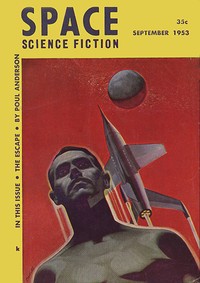
The Variable Man
Written by Philip K. Dick
Chaptra reads alongside you — AI insights, chapter breakdowns and reader discussions for every book. Join free
About this book
Read it with a club
Chaptra's fiction clubs — small groups reading the same books and talking as they go.


CraxMe Readers Book Club
Fiction
- 385 members
- 227 discussions
- Started December 2025
Welcome to the Readers Book Club. This is an informal group for like-minded people, where you can discuss books, share and recommend, track your reading progress, and lots more. Discuss Books — all about books. Discuss a particular book or genre, share your favourite quotes. Book Reviews — loved a book and highly recommend it? Or was it just average? Share your review and discuss with fellow readers. (May contain spoilers.) Group Reads — what is a book club without a group read! Buddy Reads — planning to read a book and looking for someone to read it with? Post in the Buddy Read request thread, find a reading buddy, and start discussing.
Read The Variable Man alongside people who are reading it too.
Also here: Doorstops, First Lines Club
Chaptra Prime — paid clubs, every club feature, and unlimited reading support, for $5 a month or $60 once.
See PrimeReading guide
Themes, characters and key ideas in The Variable Man, written by Chaptra AI.
- about 8 hours
- intermediate
- futuristic
- tense
- philosophical
Philip K. Dick's "The Variable Man" plunges readers into a tense 20th-century futurist world on the brink of interplanetary war between Earth and the Centauran Empire. The narrative centers on Thomas Cole, an ordinary man from the past, inadvertently pulled into this advanced future, whose simple, intuitive skills confound the highly sophisticated, predictive war machines. His unexpected presence and actions challenge the deterministic systems governing military strategy, forcing a re-evaluation of fate, free will, and the unpredictable nature of human agency. Ultimately, Cole becomes the critical 'variable' that could either save humanity or irrevocably alter the course of an inevitable conflict, highlighting the enduring tension between human intuition and technological control.
“"The machines said it was impossible. Cole simply *was*."”
Key themes
- Determinism vs. Free Will
- This is the central philosophical conflict of the novel. The future society, particularly its military, operates under the assumption of absolute determinism, where every event and human action can be predicted by advanced machines. Thomas Cole's unexpected arrival and unpredictable nature directly challenge this notion, suggesting that genuine free will and human variability can disrupt even the most sophisticated deterministic systems.
- Humanity vs. Technology/Machines
- The novel explores the complex relationship between humanity and the technology it creates. The future society has become overly reliant on machines for decision-making, particularly in critical areas like war. This reliance creates a sterile, predictable existence that undervalues human intuition, creativity, and the capacity for spontaneous action. Cole represents the enduring, irreducible essence of humanity that technology cannot fully replicate or control.
- Bureaucracy and Control
- Dick critiques the stifling nature of extensive bureaucratic control and its attempts to manage every aspect of life, especially in the context of war. Commissioner Reinhart and the military establishment represent a system obsessed with control, order, and predictable outcomes, leaving no room for deviation or spontaneous action. Cole's presence highlights the inherent fragility of such overly controlled systems when faced with genuine unpredictability.
Worth discussing
To what extent do you believe human free will can truly defy deterministic systems, whether technological or societal?
Chapter-by-chapter breakdowns, character arcs and the full thematic analysis come with a free account.
Discussions
No one has started one yet
Questions this book opens up
No discussions yet
Be the first to start a discussion about this book!
Sign up to start the discussionReviews
No reviews yet
Be the first to review this book!