
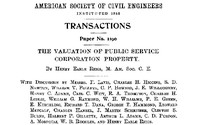
The Valuation of Public Service Corporation Property: Transactions of the American Society of Civil Engineers,; vol. LXXII, June, 1911, ASCE 1190
Written by Henry Earle Riggs
Chaptra reads alongside you — AI insights, chapter breakdowns and reader discussions for every book. Join free
About this book
Reading guide
Themes, characters and key ideas in The Valuation of Public Service Corporation Property: Transactions of the American Society of Civil Engineers,; vol. LXXII, June, 1911, ASCE 1190, written by Chaptra AI.
- about 12 hours
- advanced
- analytical
- foundational
- serious
Henry Earle Riggs's "The Valuation of Public Service Corporation Property" is a seminal early 20th-century scientific publication addressing the complex methodologies for appraising assets of public service corporations. The work meticulously outlines the necessity of accurate and fair valuations, driven by both public interest concerns for transparency and equitable rates, and corporate needs for sound investment and transaction guidance. Riggs delves into the evolving challenges faced by engineers in this specialized field, advocating for systematic approaches that integrate economic factors and the intricate relationship between corporations and the public they serve. It stands as a foundational text for engineers, policymakers, and scholars interested in the intersection of infrastructure, economics, and public policy.
“The valuation of public service corporation property presents problems of peculiar difficulty and complexity.”
Key themes
- Fairness in Valuation
- This theme is central to Riggs's work, emphasizing that property valuations for public service corporations must be equitable to both the corporation (ensuring fair returns and investment guidance) and the public (ensuring fair rates and transparency). Riggs argues for methodologies that prevent either undue corporate profit at public expense or insufficient corporate income that jeopardizes service quality. It's about finding a just economic balance.
- Methodological Rigor and Systematic Approaches
- A core tenet of Riggs's work is the absolute necessity for scientific, systematic, and rigorous methodologies in valuation. He argues against ad-hoc or subjective appraisal methods, advocating for clearly defined, defendable, and consistent frameworks. This theme reflects the Progressive Era's broader push for expert-led, data-driven governance and efficiency, applying engineering principles to economic problems.
- Public Interest vs. Corporate Operations
- Riggs deeply explores the inherent tension between the profit-driven motives of public service corporations and their mandate to serve the public good. The valuation process becomes a critical battleground where these competing interests must be reconciled. The book underscores the engineer's role in navigating this delicate balance, ensuring that corporate operations remain viable while simultaneously safeguarding the public's right to fair service and reasonable rates.
Worth discussing
How do Riggs's arguments for systematic valuation in 1911 resonate with contemporary debates about infrastructure investment and public-private partnerships?
Chapter-by-chapter breakdowns, character arcs and the full thematic analysis come with a free account.
Discussions
No one has started one yet
Questions this book opens up
No discussions yet
Be the first to start a discussion about this book!
Sign up to start the discussionReviews
No reviews yet
Be the first to review this book!