
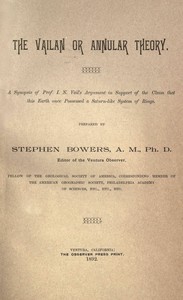
The Vailan or annular theory: A synopsis of Prof. I. N. Vail's argument in support of the claim that this Earth once possessed a Saturn-like system of rings
Written by Stephen Bowers
Chaptra reads alongside you — AI insights, chapter breakdowns and reader discussions for every book. Join free
About this book
Reading guide
Themes, characters and key ideas in The Vailan or annular theory: A synopsis of Prof. I. N. Vail's argument in support of the claim that this Earth once possessed a Saturn-like system of rings, written by Chaptra AI.
- about 8 hours
- advanced
- Analytical
- Speculative
- Challenging
Stephen Bowers's "The Vailan or annular theory" presents a detailed synopsis of Prof. I. N. Vail's radical hypothesis asserting that Earth once harbored a Saturn-like system of aqueous vapor rings. This theory posits that the gradual descent and eventual collapse of these celestial rings profoundly shaped Earth's geological landscape, explaining phenomena such as mountain formation, coal deposits, glaciation, and the moon's apparent orbital changes. Crucially, Vail connects the final descent of these rings to the biblical account of Noah's flood, offering a scientific explanation for ancient narratives. The work aims to provoke scientific discourse, challenging conventional geological paradigms by suggesting an intricate, catastrophic link between cosmic and terrestrial evolutionary events.
“This Earth once possessed a Saturn-like system of rings, explaining various geological phenomena and the biblical account of the Noachian deluge.”
Key themes
- Scientific Speculation and Unorthodox Theories
- The core theme explores the nature of scientific inquiry, particularly the development and presentation of theories that challenge established scientific consensus. Vail's annular theory represents a bold act of speculation, proposing an entirely new framework to explain existing data, pushing the boundaries of conventional thought.
- Reconciliation of Science and Religion
- A significant aspect of Vail's theory is its explicit attempt to provide a scientific explanation for biblical narratives, specifically the Noachian deluge. This theme explores the historical tension and attempts at harmony between scientific discovery and religious belief, particularly in the 19th century when geology was challenging literal interpretations of creation.
- Catastrophism vs. Uniformitarianism
- The book implicitly (and explicitly, by challenging 'conventional understanding') engages with the fundamental geological debate of its era: whether Earth's features were primarily formed by slow, gradual processes (uniformitarianism) or by sudden, violent, short-lived events (catastrophism). Vail's annular theory is a prime example of a catastrophist model, attributing massive geological changes to dramatic cosmic events.
Worth discussing
How does Vail's annular theory exemplify the scientific method of its time, and where does it diverge from modern scientific practice?
Chapter-by-chapter breakdowns, character arcs and the full thematic analysis come with a free account.
Discussions
No one has started one yet
Questions this book opens up
No discussions yet
Be the first to start a discussion about this book!
Sign up to start the discussionReviews
No reviews yet
Be the first to review this book!