
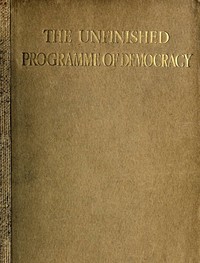
The Unfinished Programme of Democracy
Written by Richard Roberts
Chaptra reads alongside you — AI insights, chapter breakdowns and reader discussions for every book. Join free
About this book
Reading guide
Themes, characters and key ideas in The Unfinished Programme of Democracy, written by Chaptra AI.
- about 8 hours
- advanced
- Thought-provoking
- analytical
- critical
Richard Roberts' "The Unfinished Programme of Democracy" is an early 20th-century socio-political treatise that critically examines the state of modern democracy. Roberts argues that while political democratic structures have been established, the deeper social and economic dimensions essential for true democratic ideals remain unfulfilled. He critiques the narrow perception of democracy as merely a political system, advocating instead for a comprehensive approach encompassing economic equality and moral responsibility. The book warns that neglecting these broader aspects risks the decay of democratic principles and a regression into new forms of privilege, urging substantial reforms across all societal spheres to realize democracy's full potential.
“The true programme of democracy remains unfinished, its promises unfulfilled in the vast realms of social and economic life.”
Key themes
- The Incompleteness of Democracy
- This is the central thesis of the book, arguing that despite the establishment of democratic political systems, the broader social, economic, and ethical dimensions necessary for a truly flourishing democracy remain unfulfilled. Roberts posits that democracy is not a static achievement but an ongoing project, constantly requiring adaptation and expansion beyond mere electoral processes.
- Economic Equality as a Democratic Imperative
- Roberts argues that genuine political democracy cannot exist without a foundation of economic justice. He critiques systems that allow for vast wealth disparities, asserting they undermine the principles of equality and participation essential to democratic life, creating new forms of privilege and authority that negate political freedoms.
- Moral and Ethical Foundations of Society
- Roberts emphasizes that democracy is not merely a set of rules but requires a strong ethical underpinning and a sense of collective moral responsibility among its citizens. He suggests that a decline in moral consciousness, an overemphasis on individualistic pursuits, or a lack of shared values can erode democratic ideals and lead to societal decay.
Worth discussing
How does Roberts' early 20th-century critique of democracy resonate with contemporary challenges facing democratic nations today?
Chapter-by-chapter breakdowns, character arcs and the full thematic analysis come with a free account.
Discussions
No one has started one yet
Questions this book opens up
No discussions yet
Be the first to start a discussion about this book!
Sign up to start the discussionReviews
No reviews yet
Be the first to review this book!