
Chaptra
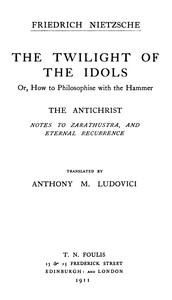
Cover of The Twilight of the Idols; or, How to Philosophize with the Hammer. The Antichrist: Complete Works, Volume Sixteen

The Twilight of the Idols; or, How to Philosophize with the Hammer. The Antichrist: Complete Works, Volume Sixteen

Written by Friedrich Wilhelm Nietzsche

Not rated yet — tap a star to review it

Chaptra reads alongside you — AI insights, chapter breakdowns and reader discussions for every book. Join free

About this book

"The Twilight of the Idols; or, How to Philosophize with the Hammer" by Friedrich Nietzsche is a philosophical treatise written in the late 19th century. This work serves as a critical examination of traditional values in Western philosophy and morality, articulating Nietzsche's call for a profound reassessment and "transvaluation" of these values. Central to the work is the idea that many long-held beliefs, particularly those stemming from religious and moral doctrines, have become idols that require destruction to clear the way for a more life-affirming philosophy. The opening of "The Twilight of the Idols" sets the stage for Nietzsche's sweeping critique of societal norms and philosophies that undermine individual strength and vitality. It features a translator’s preface that provides background on the work's brief composition timeframe and its significance in Nietzsche's oeuvre. The preface emphasizes Nietzsche's intent to challenge entrenched beliefs that he sees as harmful, claiming that the "old truth" is becoming irrelevant as humanity faces a new and empowered understanding of existence. Nietzsche expresses his conviction that current interpretations of morality do not serve life but rather promote a stance of decay and resentment against it. Throughout this groundwork, the author foreshadows the profound arguments he will present in the subsequent sections, illuminating his vision to invigorate human potential.

Reading guide

Themes, characters and key ideas in The Twilight of the Idols; or, How to Philosophize with the Hammer. The Antichrist: Complete Works, Volume Sixteen, written by Chaptra AI.

  • about 8 hours
  • advanced
  • Provocative
  • Challenging
  • Intellectual

Friedrich Nietzsche's "The Twilight of the Idols" is a trenchant philosophical treatise that serves as a radical critique of Western philosophy, morality, and culture. Written with the intent to 'philosophize with a hammer,' the work systematically dismantles traditional values, particularly those rooted in Socratic rationalism and Christian ethics, which Nietzsche views as expressions of decadence and anti-life instincts. He advocates for a profound 'transvaluation of all values,' urging humanity to reassess and ultimately shatter deeply ingrained 'idols' that he believes undermine individual strength, vitality, and the will to power. The book is an essential articulation of Nietzsche's mature thought, laying groundwork for a more life-affirming and aristocratic philosophy that celebrates human potential beyond conventional moral frameworks.

My formula for greatness in a human being is amor fati: that one wants nothing to be different, not forwards, not backwards, not in all eternity. Not merely to bear what is necessary, still less to conceal it—all idealism is mendacity in the face of what is necessary—but to love it.

Key themes

Transvaluation of All Values
This is the central, overarching theme of the book. Nietzsche argues that the traditional values of Western civilization—derived from Socratic rationalism and Christian morality—are life-denying and symptomatic of decadence. He calls for a radical re-evaluation, a 'transvaluation,' where values are judged based on their promotion of strength, vitality, and the will to power, rather than weakness, asceticism, or pity. This involves overturning traditional good/evil distinctions.
Decadence and the Will to Power
Nietzsche views decadence as a pervasive sickness in Western culture, characterized by a decline in vitality, strength, and life-affirming instincts. He attributes this to the suppression of the 'will to power'—his fundamental concept of an inherent drive in all living things to grow, assert, and overcome. Decadence manifests in various forms, from the Socratic elevation of reason to the 'sickly' morality of Christianity, which he sees as born of weakness and resentment against life.
Critique of Morality and Religion
Nietzsche conducts a scathing critique of traditional morality, particularly Christian morality, arguing that it is 'anti-nature' and has historically served to weaken humanity. He asserts that moral concepts like 'good' and 'evil' are not objective truths but human constructions, often arising from the resentment of the weak against the strong. Similarly, religion is seen as a system that invents imaginary causes and a 'true world' to escape the realities of the present, thus devaluing life itself.

Worth discussing

What does Nietzsche mean by 'philosophizing with a hammer,' and how effective is this method in the book?

Chapter-by-chapter breakdowns, character arcs and the full thematic analysis come with a free account.

Discussions

No one has started one yet

Join

Questions this book opens up

No discussions yet

Be the first to start a discussion about this book!

Sign up to start the discussion

Reviews

No reviews yet

Be the first to review this book!