
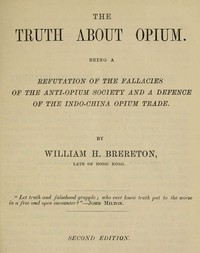
The truth about opium : $b being a refutation of the fallacies of the Anti-Opium Society and a defence of the Indo-China opium trade
Written by William H. Brereton
Chaptra reads alongside you — AI insights, chapter breakdowns and reader discussions for every book. Join free
About this book
Reading guide
Themes, characters and key ideas in The truth about opium : $b being a refutation of the fallacies of the Anti-Opium Society and a defence of the Indo-China opium trade, written by Chaptra AI.
- about 8 hours
- advanced
- argumentative
- controversial
- historical
William H. Brereton's "The Truth About Opium" is a late 19th-century polemic that staunchly defends the Indo-China opium trade, directly refuting the claims and 'fallacies' put forth by the Anti-Opium Society. Drawing upon his extensive personal experience living in Hong Kong, Brereton aims to provide a counter-narrative, asserting that opium use, particularly among the Chinese population, is often moderate and poses no significant harm or widespread societal degradation as depicted by abolitionists. The work functions as an economic and cultural justification for the continued trade, challenging prevailing moralistic views with a pragmatic, experience-based perspective. It ultimately argues that the anti-opium movement is misinformed and based on hearsay rather than direct observation of the realities of opium consumption in the region.
“The truth about opium: being a refutation of the fallacies of the Anti-Opium Society and a defence of the Indo-China opium trade.”
Key themes
- Colonial Justification and Imperialism
- The book serves as a direct defense of a significant economic pillar of the British Empire's presence in Asia. Brereton's arguments implicitly or explicitly justify the continuation of the Indo-China opium trade, framing it as an acceptable or even benign aspect of colonial governance and commerce, thereby upholding the broader imperial project against moralistic critiques. This theme explores how economic interests were rationalized within the imperial framework.
- The Nature of Truth and Propaganda
- Brereton's title, 'The Truth About Opium,' immediately signals a contest over information and narrative. The book positions itself as the purveyor of factual, experience-based knowledge, directly refuting the 'fallacies' and 'hearsay' attributed to the Anti-Opium Society. This highlights how 'truth' is constructed and contested in public discourse, often serving specific political or economic agendas. It demonstrates the use of rhetoric and appeals to authority (personal experience) to control the dominant narrative.
- Cultural Relativism vs. Universal Morality
- Brereton implicitly argues for a form of cultural relativism regarding opium use, suggesting that its effects and social implications in China differ from Western moralistic condemnations. He contends that opium smoking is a 'common practice' and, when used in 'moderation,' poses 'no significant harm,' challenging universal judgments about the substance's inherent evil. This theme explores the tension between applying universal moral standards and understanding practices within their specific cultural contexts, though Brereton's application is arguably self-serving.
Worth discussing
To what extent can personal experience be a reliable source of 'truth' in complex socio-economic debates, particularly when personal interests are involved?
Chapter-by-chapter breakdowns, character arcs and the full thematic analysis come with a free account.
Discussions
No one has started one yet
Questions this book opens up
No discussions yet
Be the first to start a discussion about this book!
Sign up to start the discussionReviews
No reviews yet
Be the first to review this book!