
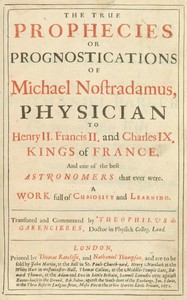
The true prophecies or prognostications of Michael Nostradamus, physician to Henry II. Francis II. and Charles IX. Kings of France, and one of the best astronomers that ever were.: A work full of curiosity and learning. Translated and commented by Theophilus de Garencieres, Doctor in Physick Colleg. Lond.
Written by Nostradamus
Chaptra reads alongside you — AI insights, chapter breakdowns and reader discussions for every book. Join free
About this book
Reading guide
Themes, characters and key ideas in The true prophecies or prognostications of Michael Nostradamus, physician to Henry II. Francis II. and Charles IX. Kings of France, and one of the best astronomers that ever were.: A work full of curiosity and learning. Translated and commented by Theophilus de Garencieres, Doctor in Physick Colleg. Lond., written by Chaptra AI.
- about 30 hours
- advanced
- mysterious
- enigmatic
- historical
"The True Prophecies or Prognostications of Michael Nostradamus," translated and commented by Theophilus de Garencieres, presents a mid-17th-century English rendition of the enigmatic prophecies of Michel Nostradamus. This volume aims to demystify Nostradamus's cryptic quatrains, offering Garencieres' extensive interpretations and historical context for the foretold events, particularly focusing on European political and social upheavals. The work grapples with the inherent ambiguity of prophetic texts, with Garencieres acknowledging the challenges of translating and assigning definitive meanings to verses filled with obscure language and multiple interpretations. It serves as a significant historical document, reflecting both the enduring fascination with Nostradamus's predictions and the scholarly attempts to rationalize and contextualize them within a specific historical framework, inviting readers to engage thoughtfully with the blend of astrology, history, and literary artistry.
“From the aquatic triplicity there shall be born one who will make Thursday his feast day: his renown, praise, rule, and power, by land and sea, will raise a tempest in the East.”
Key themes
- Prophecy and Interpretation
- This is the central theme, exploring the nature of foresight, the act of foretelling future events, and the subsequent efforts to decipher and validate such predictions. The book highlights the inherent ambiguity of prophetic language, its reliance on symbolism and allegory, and the subjective nature of its interpretation, often shaped by the interpreter's own time and biases.
- Fate vs. Free Will
- Implicit in any work of prophecy is the tension between a predetermined future and the capacity for human choice. Nostradamus's predictions often suggest an inevitable unfolding of events, raising questions about the extent of human agency in shaping destiny. Garencieres' commentary, by identifying 'fulfilled' prophecies, reinforces a sense of preordination.
- The Nature of Knowledge and Truth
- The book implicitly questions how knowledge about the future can be acquired and validated. It explores different epistemologies – from divine inspiration (prophecy) to empirical observation (Garencieres' historical research). The ambiguity of Nostradamus's text forces a consideration of what constitutes 'truth' when dealing with predictions, highlighting the difference between verifiable fact and interpretive belief.
Worth discussing
To what extent do Garencieres' personal biases and historical context influence his interpretations of Nostradamus's prophecies?
Chapter-by-chapter breakdowns, character arcs and the full thematic analysis come with a free account.
Discussions
No one has started one yet
Questions this book opens up
No discussions yet
Be the first to start a discussion about this book!
Sign up to start the discussionReviews
No reviews yet
Be the first to review this book!