
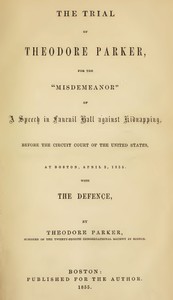
The Trial of Theodore Parker: For the "Misdemeanor" of a Speech in Faneuil Hall against Kidnapping, before the Circuit Court of the United States, at Boston, April 3, 1855, with the Defence
Written by Theodore Parker
Chaptra reads alongside you — AI insights, chapter breakdowns and reader discussions for every book. Join free
About this book
Reading guide
Themes, characters and key ideas in The Trial of Theodore Parker: For the "Misdemeanor" of a Speech in Faneuil Hall against Kidnapping, before the Circuit Court of the United States, at Boston, April 3, 1855, with the Defence, written by Chaptra AI.
- about 8 hours
- advanced
- Didactic
- Inspirational
- Historical
The Trial of Theodore Parker is a pivotal historical account from the mid-19th century, documenting the legal proceedings against the prominent abolitionist minister, Theodore Parker. Indicted for delivering an impassioned speech in Faneuil Hall condemning the kidnapping of fugitive slaves, Parker uses his trial as a platform to articulate a powerful defense of freedom of speech and the supremacy of moral law over unjust statutes. The book details the charges, the political climate surrounding the Fugitive Slave Act, and Parker's unwavering commitment to human rights, framing his personal legal battle as a broader struggle for justice and integrity in a nation deeply divided by slavery. It serves as both a historical record and a compelling argument for civil disobedience in the face of systemic oppression.
“I stand here to-day, not to defend myself, but to defend the cause of freedom and justice.”
Key themes
- Freedom of Speech and Dissent
- This is a paramount theme, as Parker's trial is a direct challenge to his right to speak freely against government policy. The book vigorously defends the necessity of allowing dissenting voices, especially when addressing perceived injustices. Parker argues that silencing critics is a hallmark of oppression and that robust public discourse is essential for a healthy democracy.
- Moral Law vs. Statutory Law
- Parker's central philosophical argument is that there exists a 'higher law'—a universal moral code, often divinely inspired or naturally inherent—that supersedes human-made statutes, especially when those statutes are unjust. He posits that laws violating fundamental human rights, like the Fugitive Slave Act, are illegitimate and carry no moral obligation for obedience.
- Abolitionism and Human Rights
- While framed as a trial about speech, the underlying cause is the abolition of slavery and the assertion of fundamental human rights for all individuals, regardless of race. Parker's speech and defense are deeply rooted in the abolitionist movement's conviction that slavery is a profound moral evil and an egregious violation of inherent human dignity.
Worth discussing
To what extent should individuals obey laws they consider morally unjust? What are the implications of civil disobedience?
Chapter-by-chapter breakdowns, character arcs and the full thematic analysis come with a free account.
Discussions
No one has started one yet
Questions this book opens up
No discussions yet
Be the first to start a discussion about this book!
Sign up to start the discussionReviews
No reviews yet
Be the first to review this book!