
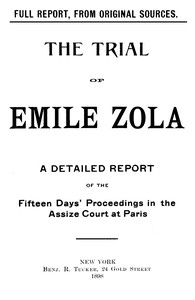
The trial of Emile Zola: containing M. Zola's letter to President Faure relating to the Dreyfus case, and a full report of the fifteen days' proceedings in the Assize Court of the Seine, including testimony of witnesses and speeches of counsel
Written by Émile Zola
Chaptra reads alongside you — AI insights, chapter breakdowns and reader discussions for every book. Join free
About this book
Reading guide
Themes, characters and key ideas in The trial of Emile Zola: containing M. Zola's letter to President Faure relating to the Dreyfus case, and a full report of the fifteen days' proceedings in the Assize Court of the Seine, including testimony of witnesses and speeches of counsel, written by Chaptra AI.
- about 12 hours
- advanced
- urgent
- dramatic
- analytical
This historical document meticulously records the sensational 1898 libel trial of Émile Zola, initiated after his explosive open letter, "J'accuse!," accused the French military of a conspiracy to wrongfully convict Captain Alfred Dreyfus of treason. The book presents Zola's full letter, alongside extensive transcripts of the fifteen-day proceedings, including witness testimonies and legal arguments, offering an unparalleled window into the political and social turmoil of the Dreyfus Affair. It serves as a powerful testament to Zola's courageous stand against institutional injustice, widespread anti-Semitism, and governmental corruption, ultimately illuminating a pivotal moment in French history where truth and justice battled overwhelming state power and public sentiment.
“"J'accuse!"”
Key themes
- Justice vs. Injustice
- This is the overarching theme, as the entire trial revolves around the monumental injustice perpetrated against Alfred Dreyfus and Zola's fight to rectify it. The book meticulously details how the French military and judiciary prioritized institutional 'honor' and nationalistic fervor over a fair legal process, leading to a profound miscarriage of justice. Zola's actions are a direct challenge to this perversion of justice, demanding that truth and fairness prevail.
- Truth vs. Deception and Corruption
- The trial is a battleground for truth. Zola's "J'accuse!" is a direct assault on the lies and cover-ups propagated by the military establishment. The testimonies during the trial reveal the layers of deception, forgery, and official obstruction employed to maintain the false narrative of Dreyfus's guilt. The theme explores the difficulty and danger of speaking truth to power, and the lengths to which powerful institutions will go to suppress inconvenient facts.
- Anti-Semitism and Prejudice
- The underlying and pervasive force driving the Dreyfus Affair was anti-Semitism, which allowed for the scapegoating of a Jewish officer and the public's acceptance of his guilt without sufficient evidence. The trial, while ostensibly about libel, implicitly exposes the deep-seated prejudice within French society and institutions. Zola's defense, by advocating for Dreyfus, implicitly challenges this bigotry, making the trial a crucial moment in the fight against religious and ethnic discrimination.
Worth discussing
How does Zola's "J'accuse!" embody the power of the written word in inciting social and political change?
Chapter-by-chapter breakdowns, character arcs and the full thematic analysis come with a free account.
Discussions
No one has started one yet
Questions this book opens up
No discussions yet
Be the first to start a discussion about this book!
Sign up to start the discussionReviews
No reviews yet
Be the first to review this book!