
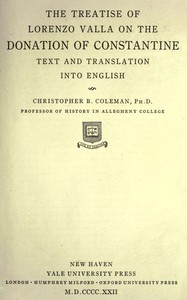
The treatise of Lorenzo Valla on the Donation of Constantine
Written by Lorenzo Valla
Chaptra reads alongside you — AI insights, chapter breakdowns and reader discussions for every book. Join free
About this book
Reading guide
Themes, characters and key ideas in The treatise of Lorenzo Valla on the Donation of Constantine, written by Chaptra AI.
- about 8 hours
- advanced
- Scholarly
- Polemical
- Critical
Lorenzo Valla's "The Treatise on the Donation of Constantine" is a seminal work of Renaissance humanism, meticulously dissecting and refuting the authenticity of the medieval legal document known as the Donation of Constantine. Written in the early 15th century, Valla’s treatise employs rigorous historical and linguistic criticism to expose the document as a forgery, thereby challenging the very foundation of papal temporal authority and its claims to vast territories and secular power. He systematically dismantles the Donation's assertions by highlighting anachronisms, logical inconsistencies, and absurdities, arguing that such a grant from Emperor Constantine to Pope Sylvester I was historically impossible and legally unsound. This audacious critique not only underscored Valla's commitment to truth and scholarly inquiry but also laid crucial groundwork for modern historical methodology and significantly influenced subsequent political and religious discourse.
“How could such a magnanimous emperor, having just founded a new capital, relinquish the very seat of his empire to a bishop?”
Key themes
- Historical Truth vs. Fabrication
- This is the central theme of the treatise. Valla's entire project is dedicated to uncovering historical truth by exposing a long-standing, politically motivated fabrication. He champions the rigorous examination of sources, challenging the acceptance of tradition and authority without critical scrutiny. This theme highlights the power of evidence-based inquiry over unverified claims.
- Authority: Ecclesiastical vs. Secular
- The treatise directly challenges the temporal authority of the Papacy, which was largely predicated on the Donation of Constantine. By proving the document a forgery, Valla undermines the Church's claims to vast territories and secular dominion, implicitly advocating for a clearer separation or rebalancing of power between religious and secular rulers.
- Renaissance Humanism and Critical Inquiry
- Valla's work is a quintessential example of Renaissance humanism, emphasizing the study of classical texts, the revival of classical Latin, and a new critical approach to knowledge. He embodies the humanist spirit of questioning received wisdom, returning to original sources ('ad fontes'), and using human reason and philology to understand the past more accurately.
Worth discussing
How does Valla's treatise exemplify the spirit and methods of Renaissance humanism?
Chapter-by-chapter breakdowns, character arcs and the full thematic analysis come with a free account.
Discussions
No one has started one yet
Questions this book opens up
No discussions yet
Be the first to start a discussion about this book!
Sign up to start the discussionReviews
No reviews yet
Be the first to review this book!