
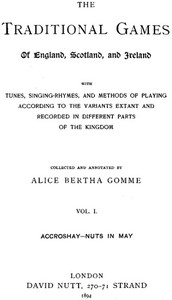
The Traditional Games of England, Scotland, and Ireland (Vol 1 of 2): With Tunes, Singing-Rhymes and Methods of Playing etc.
Written by Alice Bertha Gomme
Chaptra reads alongside you — AI insights, chapter breakdowns and reader discussions for every book. Join free
About this book
Reading guide
Themes, characters and key ideas in The Traditional Games of England, Scotland, and Ireland (Vol 1 of 2): With Tunes, Singing-Rhymes and Methods of Playing etc., written by Chaptra AI.
- about 25 hours
- advanced
- Informative
- Scholarly
- Historical
Alice Bertha Gomme's "The Traditional Games of England, Scotland, and Ireland (Vol 1 of 2)" is a monumental late 19th-century ethnographic collection documenting hundreds of children's folk games. It meticulously details rules, singing-rhymes, and regional variants, aiming to preserve these ephemeral traditions. Beyond mere amusement, Gomme explores the games' deep connections to historical customs, adult pastimes, and the broader cultural fabric of British and Irish societies. The volume serves as both a comprehensive dictionary and an insightful anthropological study, offering a unique window into the practices and beliefs embedded in the culture of childhood. It stands as a foundational work in folklore studies, highlighting the enduring significance of play.
“Children's games are not only pastimes but are often derived from older, adult customs and serve as reflections of the culture from which they originate.”
Key themes
- Cultural Preservation
- This is the overarching theme. Gomme's primary motivation for compiling this extensive work was to document and preserve the traditional games of England, Scotland, and Ireland before they were lost to modernization and changing social habits. She recognized the ephemeral nature of oral traditions and sought to create a lasting record. The book serves as a historical archive, ensuring that future generations can access and understand these aspects of their cultural heritage.
- Childhood and Play
- The book offers an invaluable historical perspective on childhood, specifically focusing on the role of play in children's lives in the late 19th century. It challenges the notion of play as mere triviality, instead presenting it as a fundamental aspect of development, social learning, and cultural transmission. The collection provides insight into how children interacted, learned social rules, and engaged with their environment through structured and unstructured play.
- Folklore and Oral Tradition
- Gomme's work is a pioneering example of folklore study, specifically focusing on the oral traditions embedded in children's games. It demonstrates how rhymes, tunes, and rules are passed down through generations, often without formal instruction, highlighting the resilience and adaptability of folk culture. The book meticulously documents these oral elements, providing a tangible record of an otherwise ephemeral cultural form.
Worth discussing
What is the significance of preserving traditional games in an increasingly digital world, and how do Gomme's arguments resonate today?
Chapter-by-chapter breakdowns, character arcs and the full thematic analysis come with a free account.
Discussions
No one has started one yet
Questions this book opens up
No discussions yet
Be the first to start a discussion about this book!
Sign up to start the discussionReviews
No reviews yet
Be the first to review this book!