
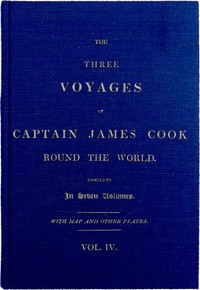
The Three Voyages of Captain Cook Round the World. Vol. IV. Being the Second of the Second Voyage.
Written by James Cook,Georg Forster
Chaptra reads alongside you — AI insights, chapter breakdowns and reader discussions for every book. Join free
About this book
Reading guide
Themes, characters and key ideas in The Three Voyages of Captain Cook Round the World. Vol. IV. Being the Second of the Second Voyage., written by Chaptra AI.
- about 8 hours
- advanced
- historical
- adventurous
- informative
Volume IV of "The Three Voyages of Captain Cook Round the World," co-authored by James Cook and Georg Forster, meticulously chronicles the second leg of Cook's second expedition, focusing on his journey from Ulietea to the Friendly Isles. This historical account, originating from the early 19th century, details Cook's pioneering explorations, the discovery of new islands, and the extensive documentation of their geographical features and natural environments. The narrative vividly portrays significant encounters with indigenous populations, highlighting both the challenges of navigation through uncharted waters and the complexities of cross-cultural interactions, which occasionally escalated into skirmishes. It serves as a crucial primary source, offering insights into 18th-century scientific observation, the spirit of adventure, and the nascent stages of European colonial engagement in the Pacific.
“It is by a steady perseverance in the pursuit of our object that we are to hope for success.”
Key themes
- Exploration and Discovery
- This theme is central, detailing the relentless drive to chart unknown territories, discover new lands, and expand the geographical knowledge of the world. It encompasses the spirit of adventure, the challenges of navigation, and the joy of uncovering the unknown.
- Cross-Cultural Encounter and Conflict
- The interactions between Cook's crew and the indigenous populations are a core theme, illustrating the complexities, misunderstandings, and occasional conflicts that arise when vastly different cultures meet. It explores initial awe, trade, cultural exchange, and moments of tension or violence.
- Scientific Observation and Documentation
- Reflecting the Enlightenment era's emphasis on empirical knowledge, this theme highlights the meticulous recording of geographical, botanical, zoological, and ethnographic data. The voyage was not just about discovery but about systematic cataloging and understanding the natural world.
Worth discussing
How does Cook's narrative reflect the scientific and philosophical ideals of the Enlightenment?
Chapter-by-chapter breakdowns, character arcs and the full thematic analysis come with a free account.
Discussions
No one has started one yet
Questions this book opens up
No discussions yet
Be the first to start a discussion about this book!
Sign up to start the discussionReviews
No reviews yet
Be the first to review this book!