
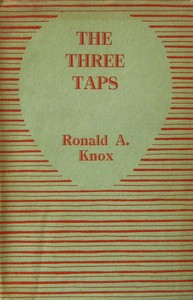
The three taps : $b A detective story without a moral
Written by Ronald Arbuthnott Knox
Chaptra reads alongside you — AI insights, chapter breakdowns and reader discussions for every book. Join free
About this book
Reading guide
Themes, characters and key ideas in The three taps : $b A detective story without a moral, written by Chaptra AI.
- about 7 hours
- intermediate
- mysterious
- witty
- intricate
Ronald Arbuthnott Knox's "The Three Taps" plunges insurance investigator Miles Bredon into a perplexing locked-room mystery centered on the suspicious death of wealthy Mr. Mottram. Mottram, insured by the peculiar 'Indescribable' company with a Euthanasia policy, is found dead from gas poisoning, leading Bredon to unravel a complex web of deceit involving an open window, a sealed room, and the intricate workings of the unusual insurance scheme. The novel, subtitled "A Detective Story without a Moral," cleverly dissects the ethical ambiguities surrounding death, insurance, and the pursuit of justice, all presented with Knox's signature wit and intricate plotting. Bredon navigates a labyrinth of false leads and ingenious stratagems to expose a killer whose motive is deeply intertwined with the policy's controversial stipulations, challenging the very notion of morality in detection.
“"The Indescribable's Euthanasia policy, you see, is based on the rather cynical assumption that some men are worth more dead than alive – to their heirs, at least."”
Key themes
- The Nature of Truth and Deception
- Central to any detective story, this theme is particularly pronounced in "The Three Taps" due to the elaborate nature of the crime. The entire mystery hinges on a meticulously constructed deception designed to present murder as an accident or suicide. Bredon's task is to peel back these layers of artifice, distinguishing between genuine facts, intentional misdirection, and circumstantial evidence. The novel demonstrates how easily perception can be manipulated and how truth often lies hidden beneath a facade of logic and apparent impossibility.
- Justice vs. Legality
- The novel deeply explores the tension between what is legally permissible or contractually agreed upon (the Euthanasia policy) and what constitutes moral justice. The killer's actions, while technically fulfilling certain conditions for payout under the policy, are morally reprehensible. Bredon's investigation seeks to uncover the truth, which may not align with the strict letter of the insurance contract, forcing a contemplation of whether a 'solution' to a crime inherently implies a 'moral' outcome.
- Human Ingenuity (for good and ill)
- The novel showcases the remarkable capacity of human intellect, both in conceiving an almost perfect crime and in unraveling it. The killer's plot is a testament to cunning and foresight, while Bredon's solution is a triumph of logical deduction and meticulous observation. This theme highlights that ingenuity is a neutral force, capable of being applied to destructive ends (murder, deception) or constructive ones (detection, problem-solving). It celebrates the power of the human mind to construct and deconstruct complex puzzles.
Worth discussing
How does the 'Euthanasia policy' challenge conventional notions of crime and justice in the novel?
Chapter-by-chapter breakdowns, character arcs and the full thematic analysis come with a free account.
Discussions
No one has started one yet
Questions this book opens up
No discussions yet
Be the first to start a discussion about this book!
Sign up to start the discussionReviews
No reviews yet
Be the first to review this book!