
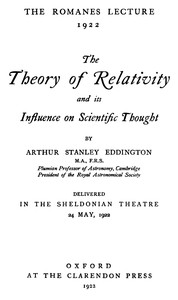
The theory of relativity and its influence on scientific thought
Written by Arthur Stanley Eddington
Not rated yet — tap a star to review it
Chaptra reads alongside you — AI insights, chapter breakdowns and reader discussions for every book. Join free
About this book
"The theory of relativity and its influence on scientific thought" by Eddington is a scientific publication delivered as the Romanes Lecture in 1922. The book discusses the revolutionary implications of Einstein's theories of relativity on our understanding of space and time, marking a significant shift in scientific thought from a geocentric to a more abstract and relativistic perspective. In this lecture, Eddington explains how Einstein's theories challenge long-held notions of fixed frames of reference, asserting that the measurements of space and time are relative to the observer’s motion. He elaborates on concepts such as the FitzGerald contraction and how they arise from the need to view physical phenomena without the distortions imposed by our earthly point of view. By illustrating the relativity of physical laws and the geometry of the universe, Eddington emphasizes the profound impact of Einstein's work on fields like mechanics and gravitation, arguing that a new understanding of the four dimensions of space-time reshapes not only physics but also our broader comprehension of existence in the cosmos.
Reading guide
Themes, characters and key ideas in The theory of relativity and its influence on scientific thought, written by Chaptra AI.
A reading guide for this book hasn't been written yet. Chaptra builds one the first time a reader opens it.
Chapter-by-chapter breakdowns, character arcs and the full thematic analysis come with a free account.
Discussions
No one has started one yet
No discussions yet
Be the first to start a discussion about this book!
Sign up to start the discussionReviews
No reviews yet
Be the first to review this book!