
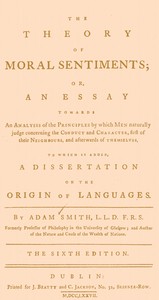
The Theory of Moral Sentiments: Or, an Essay Towards an Analysis of the Principles by Which Men Naturally Judge Concerning the Conduct and Character, First of Their Neighbours, and Afterwards of Themselves. to Which Is Added, a Dissertation on the Origin of Languages.
Written by Adam Smith
Chaptra reads alongside you — AI insights, chapter breakdowns and reader discussions for every book. Join free
About this book
Reading guide
Themes, characters and key ideas in The Theory of Moral Sentiments: Or, an Essay Towards an Analysis of the Principles by Which Men Naturally Judge Concerning the Conduct and Character, First of Their Neighbours, and Afterwards of Themselves. to Which Is Added, a Dissertation on the Origin of Languages., written by Chaptra AI.
- about 20 hours
- advanced
- philosophical
- analytical
- introspective
Adam Smith's "The Theory of Moral Sentiments" is a foundational philosophical treatise exploring the origins and mechanisms of human morality, preceding his famed economic work. Smith posits that human beings inherently possess a capacity for 'sympathy' or 'fellow-feeling,' which allows them to understand and share in the emotions of others, forming the basis for moral judgment. Central to his theory is the concept of the 'impartial spectator,' an imagined, objective observer whose perspective we internalize to judge our own actions and those of others, striving for 'propriety'—an alignment of our sentiments with what a reasonable observer would approve. The work systematically analyzes how virtues like justice, beneficence, and self-command arise from these social interactions and the desire for mutual sympathy and approbation, ultimately shaping individual character and societal norms.
“How selfish soever man may be supposed, there are evidently some principles in his nature, which interest him in the fortune of others, and render their happiness necessary to him, though he derives nothing from it except the pleasure of seeing it.”
Key themes
- Sympathy and Fellow-Feeling
- This is the foundational principle of Smith's moral philosophy. Sympathy is defined not merely as pity, but as the capacity to enter into and share the feelings of others, whether joy or sorrow, by imagining oneself in their situation. It is the initial spark that allows for moral connection and understanding between individuals.
- The Impartial Spectator and Conscience
- The impartial spectator is an imagined, objective observer whose perspective individuals internalize to judge their own actions and the actions of others. This internalization forms the basis of conscience, or 'the man within the breast,' enabling self-assessment and the pursuit of 'praise-worthiness' rather than mere 'praise.'
- Propriety and Approbation
- Propriety refers to the suitability or appropriateness of an action or sentiment to its cause, as judged by the impartial spectator. The desire for approbation (approval) from others, and ultimately from the impartial spectator, drives individuals to conform their sentiments and actions to what is deemed proper. This social feedback loop is critical for moral development.
Worth discussing
How does Smith's concept of 'sympathy' differ from modern understandings of empathy, and what are the implications for moral judgment?
Chapter-by-chapter breakdowns, character arcs and the full thematic analysis come with a free account.
Discussions
No one has started one yet
Questions this book opens up
No discussions yet
Be the first to start a discussion about this book!
Sign up to start the discussionReviews
No reviews yet
Be the first to review this book!