
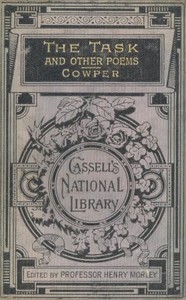
The Task, and Other Poems
Written by William Cowper
Chaptra reads alongside you — AI insights, chapter breakdowns and reader discussions for every book. Join free
About this book
Reading guide
Themes, characters and key ideas in The Task, and Other Poems, written by Chaptra AI.
- about 8 hours
- advanced
- reflective
- contemplative
- serene
William Cowper's "The Task, and Other Poems" is a seminal late 18th-century collection, with its centerpiece being the lengthy didactic poem, "The Task." This work embarks on a contemplative journey, initially prompted by the humble sofa, to explore profound themes of nature, domesticity, and the human condition. Cowper masterfully weaves personal reflection with broader societal commentary, contrasting the restorative power of rural life with the perceived artificiality of urban existence. The collection serves as a powerful testament to the simple pleasures, moral virtue, and spiritual solace found in communion with nature and the comforts of home. It encapsulates a yearning for authenticity and peace amidst the complexities of a changing world, influencing subsequent Romantic thought.
“God made the country, and man made the town.”
Key themes
- Nature as a Source of Solace and Moral Instruction
- Cowper extensively explores nature not merely as a backdrop but as a living entity that offers profound comfort, peace, and spiritual guidance. He views the natural world as God's creation, imbued with divine lessons for humanity. Through detailed descriptions of rural landscapes, gardens, and changing seasons, he illustrates how communion with nature can heal the soul, inspire virtue, and provide an antidote to the anxieties of modern life.
- Critique of Urban Life and Societal Vices
- Cowper draws a sharp contrast between the perceived purity and simplicity of rural life and the corruption, artificiality, and moral decay he associates with urban centers, particularly London. He critiques societal vanity, political ambition, the pursuit of fleeting pleasures, and the erosion of genuine human connection in the bustling city. This theme serves as a moral warning and reinforces his advocacy for a more virtuous, unpretentious existence.
- Virtue, Simplicity, and True Happiness
- Running through the entire collection is a strong didactic current advocating for a life of moral virtue, simplicity, and sincere religious faith as the true path to lasting happiness. Cowper contrasts this with the superficial pursuit of wealth, fame, and power, which he argues leads to discontent and spiritual emptiness. He champions honesty, kindness, humility, and a deep connection to God as the foundational elements of a well-lived life.
Worth discussing
How does Cowper's initial focus on the 'sofa' serve as an effective springboard for his broader philosophical and moral musings?
Chapter-by-chapter breakdowns, character arcs and the full thematic analysis come with a free account.
Discussions
No one has started one yet
Questions this book opens up
No discussions yet
Be the first to start a discussion about this book!
Sign up to start the discussionReviews
No reviews yet
Be the first to review this book!