
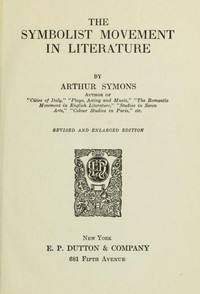
The Symbolist Movement in Literature
Written by Arthur Symons
Chaptra reads alongside you — AI insights, chapter breakdowns and reader discussions for every book. Join free
About this book
Read it with a club
Small groups reading the same books and talking as they go.


News
- 4 members
- 1,813 discussions
- Active Sep 11
Read The Symbolist Movement in Literature alongside people who are reading it too.
Also here: News Bulletin, Just Joking....
Chaptra Prime — paid clubs, every club feature, and unlimited reading support, for $5 a month or $60 once.
See PrimeReading guide
Themes, characters and key ideas in The Symbolist Movement in Literature, written by Chaptra AI.
- about 12 hours
- advanced
- intellectual
- analytical
- evocative
Arthur Symons' "The Symbolist Movement in Literature" offers a foundational exploration of Symbolism, a pivotal late 19th-century literary movement primarily rooted in French literature. Symons meticulously traces the origins and evolution of Symbolism, positioning it as a profound departure from materialistic literary representation towards an expression of deeper, often unseen spiritual truths. The work asserts that symbolism is inherent to language and human understanding, utilizing this premise to analyze the contributions of key figures like Baudelaire and Flaubert. Through a blend of historical context and critical interpretation, Symons illuminates how these authors consciously crafted a new aesthetic emphasizing suggestion, evocation, and the interplay between the visible and invisible worlds. It serves as an essential guide to understanding the philosophical underpinnings and artistic manifestations of Symbolism, solidifying its place in literary history.
“Symbolism, in its very essence, is the endeavor to spiritualize literature, to evoke rather than to state, to suggest rather than to describe.”
Key themes
- The Spiritualization of Literature
- This is the core tenet of Symbolism as presented by Symons. It argues for a move away from the materialistic and objective representation of reality towards an art that seeks to express deeper, often unseen or ineffable, spiritual truths and inner experiences. Literature becomes a means of revealing the soul, the subconscious, and the transcendent, rather than merely documenting the external world.
- Suggestion and Evocation
- A key stylistic and philosophical principle of Symbolism. Rather than direct statement or detailed description, Symbolist art aims to evoke feelings, ideas, and associations through indirect means—using symbols, metaphors, rhythm, and sound. The meaning is not explicitly stated but hinted at, allowing the reader's imagination to complete the experience and engage with the work on a deeper, more personal level.
- The Artist as Seer/Revealer
- Symons portrays the Symbolist artist not merely as a craftsman but as a privileged individual with access to deeper truths, capable of perceiving and articulating the 'unseen.' The artist's role is to act as a kind of seer or mystic, translating profound spiritual or psychological realities into symbolic forms that can be apprehended by others. This elevates the artist's status and positions art as a sacred rather than purely decorative or didactic pursuit.
Worth discussing
How does Symons define Symbolism, and what distinctions does he draw between it and previous literary movements like Realism or Naturalism?
Chapter-by-chapter breakdowns, character arcs and the full thematic analysis come with a free account.
Discussions
No one has started one yet
Questions this book opens up
No discussions yet
Be the first to start a discussion about this book!
Sign up to start the discussionReviews
No reviews yet
Be the first to review this book!