
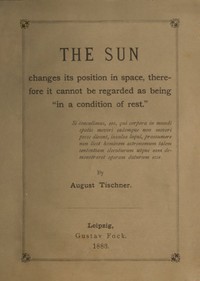
The Sun changes its position in space: therefore it cannot be regarded as being "in a condition of rest"
Written by August Tischner
Chaptra reads alongside you — AI insights, chapter breakdowns and reader discussions for every book. Join free
About this book
Reading guide
Themes, characters and key ideas in The Sun changes its position in space: therefore it cannot be regarded as being "in a condition of rest", written by Chaptra AI.
- about 8 hours
- advanced
- Analytical
- Challenging
- Scholarly
August Tischner's late 19th-century scientific treatise, "The Sun changes its position in space," critically re-examines the foundational assumption of a fixed sun within the established Copernican system. Tischner argues that ignoring the sun's inherent motion through space leads to fundamental flaws and contradictions in astronomical theory. He advocates for a radical reevaluation of astronomical principles, urging a shift from adherence to outdated dogma towards a new foundation built strictly on continuous observation and empirical evidence. By contrasting historical figures like Ptolemy, Copernicus, Kepler, and Newton, the book makes a compelling case for the dynamic nature of scientific knowledge and the necessity of evolving theories beyond past limitations.
“"The assumption of a fixed sun, while simplifying calculations, ultimately obscures the true dynamics of our celestial system."”
Key themes
- Scientific Progress vs. Dogma
- This is the central theme, exploring the inherent tension between the dynamic nature of scientific inquiry and the tendency for even groundbreaking theories to become rigid dogmas. Tischner argues that true progress necessitates a constant willingness to re-evaluate and challenge established beliefs, even those considered fundamental, when new observations or logical inconsistencies arise. He positions the 'fixed sun' assumption as a prime example of such a dogma hindering further understanding.
- Empirical Observation and Evidence
- Tischner champions a foundation of astronomy built solely on careful, continuous observation and empirical evidence, rather than theoretical convenience or historical precedent. He emphasizes that the dynamic nature of the cosmos demands a dynamic approach to knowledge acquisition, where direct observation guides theory, not the other way around. This theme reinforces the scientific method's core principles.
- The Nature of Scientific Truth
- The book implicitly explores how scientific 'truths' are not absolute or static, but provisional and subject to evolution as new data, technologies, and perspectives emerge. Tischner demonstrates that even revolutionary theories, like Copernicus's, are incomplete and have limitations, suggesting that science is a continuous process of approximation towards a more accurate understanding of reality.
Worth discussing
How does Tischner's critique of the 'fixed sun' assumption reflect the broader process of scientific progress and paradigm shifts?
Chapter-by-chapter breakdowns, character arcs and the full thematic analysis come with a free account.
Discussions
No one has started one yet
Questions this book opens up
No discussions yet
Be the first to start a discussion about this book!
Sign up to start the discussionReviews
No reviews yet
Be the first to review this book!