
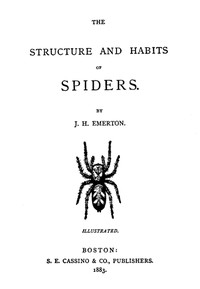
The Structure and Habits of Spiders
Written by J. H. (James Henry) Emerton
Chaptra reads alongside you — AI insights, chapter breakdowns and reader discussions for every book. Join free
About this book
Reading guide
Themes, characters and key ideas in The Structure and Habits of Spiders, written by Chaptra AI.
- about 8 hours
- intermediate
- informative
- scientific
- detailed
J. H. Emerton's "The Structure and Habits of Spiders" is a seminal late 19th-century scientific treatise offering a detailed exploration of arachnid biology. The book systematically covers spider anatomy, classification, and diverse behaviors, aiming to provide an accurate, clear account while correcting prevalent misconceptions. Through meticulous descriptions and numerous illustrations, Emerton elucidates aspects such as feeding mechanisms, silk production, reproductive processes, and the varied architectural designs of spider webs. It serves as an accessible yet comprehensive resource, reflecting the state of arachnological knowledge during its publication era and emphasizing the importance of direct observation in natural history.
“The marvels of arachnid architecture are not merely instinctual acts but the culmination of intricate anatomical design and adaptive behavior.”
Key themes
- Adaptation and Survival
- The book extensively explores how spiders' anatomical structures and behavioral habits are exquisitely adapted to their specific environments and survival needs. This theme highlights the intricate design of nature and the evolutionary pressures that shape species.
- Scientific Observation and Classification
- Emerton's work is a testament to the power of systematic observation and the importance of classification in understanding the natural world. The book demonstrates the scientific method through detailed descriptions, categorization, and the careful recording of natural phenomena.
- Debunking Misconceptions and Promoting Accuracy
- A significant underlying purpose of the book is to correct popular errors and irrational fears surrounding spiders by providing factual, scientifically accurate information. This theme emphasizes the role of science in educating the public and challenging unfounded beliefs.
Worth discussing
How does Emerton's approach to scientific observation compare to modern scientific methods?
Chapter-by-chapter breakdowns, character arcs and the full thematic analysis come with a free account.
Discussions
No one has started one yet
Questions this book opens up
No discussions yet
Be the first to start a discussion about this book!
Sign up to start the discussionReviews
No reviews yet
Be the first to review this book!