
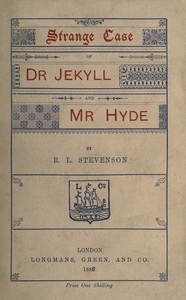
The Strange Case of Dr. Jekyll and Mr. Hyde
Written by Robert Louis Stevenson
Chaptra reads alongside you — AI insights, chapter breakdowns and reader discussions for every book. Join free
About this book
Reading guide
Themes, characters and key ideas in The Strange Case of Dr. Jekyll and Mr. Hyde, written by Chaptra AI.
- about 4 hours
- intermediate
- dark
- mysterious
- foreboding
Robert Louis Stevenson's 'The Strange Case of Dr. Jekyll and Mr. Hyde' is a chilling novella that explores the inherent duality of human nature through the story of a respected London doctor and his sinister alter ego. The narrative unfolds through the perspective of Mr. Utterson, a lawyer investigating the increasingly strange connection between his friend, Dr. Jekyll, and the malevolent Mr. Hyde. As Utterson uncovers the dark secrets behind their relationship, the story delves into themes of identity, repression, and the struggle between societal morality and primal urges. Ultimately, the novella reveals a profound and tragic experiment where one man attempts to separate the good and evil within himself, leading to a horrifying loss of control and self-destruction. Its enduring power lies in its psychological depth and its iconic portrayal of humanity's capacity for both benevolence and depravity.
“"All human beings, as we meet them, are commingled out of good and evil: and Edward Hyde, alone in the ranks of mankind, was pure evil."”
Key themes
- Duality of Human Nature
- The central theme, exploring the idea that every individual possesses both good and evil within them. Jekyll's experiment is an attempt to separate these two aspects, leading to the creation of Hyde, who embodies pure evil. The novella argues against the possibility of such a clean division, suggesting that these forces are inextricably linked.
- Reputation and Secrecy
- Set in Victorian London, the novella highlights the intense societal pressure to maintain a respectable public image, often at the cost of personal authenticity. Jekyll's entire experiment is driven by a desire to indulge his 'undignified' pleasures without compromising his esteemed reputation, leading him to create Hyde as a vessel for his secret vices.
- Good vs. Evil
- While related to duality, this theme specifically focuses on the active struggle between benevolent and malevolent forces, both within an individual and in society. Hyde represents unadulterated evil, while Jekyll, though flawed, embodies the struggle for good. The novella suggests that unchecked evil can grow and ultimately consume the good.
Worth discussing
How does Stevenson use the setting of London to enhance the novella's atmosphere and themes, particularly the idea of hidden darkness beneath a respectable surface?
Chapter-by-chapter breakdowns, character arcs and the full thematic analysis come with a free account.
Discussions
No one has started one yet
Questions this book opens up
No discussions yet
Be the first to start a discussion about this book!
Sign up to start the discussionReviews
No reviews yet
Be the first to review this book!