
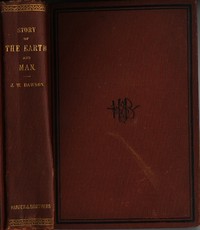
The Story of the Earth and Man
Written by John William Dawson
Chaptra reads alongside you — AI insights, chapter breakdowns and reader discussions for every book. Join free
About this book
Reading guide
Themes, characters and key ideas in The Story of the Earth and Man, written by Chaptra AI.
- about 12 hours
- advanced
- informative
- reflective
- grand
Sir John William Dawson's "The Story of the Earth and Man" is a seminal late 19th-century scientific work that meticulously traces Earth's geological history and the evolution of life. It aims to make complex geological and biological concepts accessible to a general readership, integrating scientific theories like the nebular hypothesis with spiritual reflections on creation. Dawson guides readers through various epochs, from the planet's initial 'formless and void' state to the emergence of primitive life and the formation of geological strata. The book emphasizes the profound interconnectedness between geological processes and the development of life forms, inviting a deeper appreciation for the grandeur and complexity of natural history. It serves as a significant historical document reflecting 19th-century scientific inquiry and attempts to reconcile science with religious perspectives.
“The Earth, in its earliest state, was indeed without form, and void, a vast nebula of incandescent matter awaiting the shaping hand of universal law.”
Key themes
- Interconnectedness of Geological and Biological Evolution
- A core theme emphasizing that Earth's physical history (geological events) and the history of life (biological evolution) are inextricably linked. Dawson illustrates how geological forces create environments that drive or constrain life, and conversely, how life itself can alter the planet's geology (e.g., fossil formation, atmospheric changes). This theme highlights a holistic view of Earth's development.
- Theological Geology and Progressive Creationism
- This theme explores Dawson's effort to reconcile geological and paleontological findings with a belief in divine creation. He posits a 'progressive creationism' where God guided the evolutionary process over vast periods, rather than a strict literal interpretation of Genesis or purely Darwinian natural selection. He sees the geological record as evidence of divine design and a purposeful unfolding of life.
- The Grandeur and Antiquity of Earth's History
- Dawson consistently imbues his scientific descriptions with a sense of awe and wonder at the immense scale of geological time and the profound transformations Earth has undergone. He seeks to convey the 'grandeur' of natural processes and the deep antiquity of the planet, inviting readers to appreciate the epic scope of Earth's 'story' and humanity's relatively recent arrival on this ancient stage.
Worth discussing
How does Dawson attempt to reconcile scientific findings with spiritual or religious beliefs, and what does this reveal about the intellectual climate of the late 19th century?
Chapter-by-chapter breakdowns, character arcs and the full thematic analysis come with a free account.
Discussions
No one has started one yet
Questions this book opens up
No discussions yet
Be the first to start a discussion about this book!
Sign up to start the discussionReviews
No reviews yet
Be the first to review this book!