
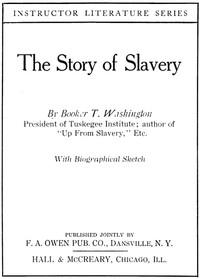
The Story of Slavery
Written by Booker T. Washington
Chaptra reads alongside you — AI insights, chapter breakdowns and reader discussions for every book. Join free
About this book
Reading guide
Themes, characters and key ideas in The Story of Slavery, written by Chaptra AI.
- about 8 hours
- intermediate
- somber
- historical
- resilient
Booker T. Washington's "The Story of Slavery" is a seminal early 20th-century historical account that meticulously traces the institution of slavery in America from the arrival of the first African slaves in 1619. Drawing upon his unique lived experience as a former slave, Washington offers a dual perspective, blending rigorous historical facts with profound personal insights into the system's brutality and its far-reaching societal and psychological impacts. The narrative chronicles the inhumane Middle Passage, the harsh realities of plantation life, and the diverse roles of enslaved individuals, while simultaneously highlighting their enduring resilience, community building, and moments of shared humanity amidst unimaginable suffering. Ultimately, the book serves as both a comprehensive historical document and a testament to the indomitable spirit of those who endured and resisted chattel slavery.
“No man can drag me down so low as to make me hate him.”
Key themes
- The Dehumanizing Nature of Slavery
- Washington meticulously details how the system of slavery stripped individuals of their autonomy, family, identity, and basic human rights, treating them as property rather than people. He covers the physical brutality, emotional trauma, and the systemic denial of education and self-determination, illustrating the complete moral bankruptcy of the institution.
- Resilience and the Human Spirit
- Despite the immense suffering and dehumanization, Washington emphasizes the enduring strength, resourcefulness, and will to survive demonstrated by enslaved people. He highlights their efforts to create community, preserve cultural practices, find moments of joy, and maintain hope against impossible odds, showcasing the indomitable nature of human spirit.
- The Evolution and Entrenchment of a System
- The book meticulously traces how slavery, initially a nascent and somewhat fluid practice, evolved into a complex, legally codified, and economically essential institution in America. Washington details the legislative acts, economic drivers (especially cash crops), and cultural norms that solidified its place for centuries, highlighting its systematic and institutional nature.
Worth discussing
How does Washington's personal experience as a former slave shape his historical account, and how might it differ from a historian who did not share that experience?
Chapter-by-chapter breakdowns, character arcs and the full thematic analysis come with a free account.
Discussions
No one has started one yet
Questions this book opens up
No discussions yet
Be the first to start a discussion about this book!
Sign up to start the discussionReviews
No reviews yet
Be the first to review this book!