
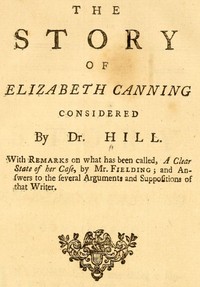
The Story of Elizabeth Canning Considered
Written by John Hill
Chaptra reads alongside you — AI insights, chapter breakdowns and reader discussions for every book. Join free
About this book
Reading guide
Themes, characters and key ideas in The Story of Elizabeth Canning Considered, written by Chaptra AI.
- about 10 hours
- advanced
- investigative
- analytical
- somber
John Hill's "The Story of Elizabeth Canning Considered" is an incisive 18th-century historical account that delves into the infamous Elizabeth Canning abduction case, a legal and public sensation of its time. Through meticulous analysis, Hill scrutinizes the conflicting testimonies and evidence, particularly focusing on Canning's claims and the counter-accusations, to argue for Canning's innocence. The book serves as a detailed examination of the judicial proceedings, highlighting how public sentiment and questionable evidence often overshadowed factual truth. Ultimately, Hill's work stands as both a passionate defense of an individual and a critical commentary on the pervasive influence of societal bias and hysteria within the justice system of the period.
“"In matters of such profound consequence as life and liberty, the scales of justice must be weighted not by public clamour, but by the unassailable truth of facts."”
Key themes
- Truth vs. Perception
- This is the central thematic conflict of the book. Hill meticulously examines how the 'truth' of Elizabeth Canning's abduction became obscured by conflicting testimonies, public opinion, and individual biases. He demonstrates that what is perceived as true can be heavily influenced by societal prejudices, emotional appeals, and the unreliable nature of human memory, often diverging significantly from objective facts.
- Justice and Injustice
- The entire book is a commentary on the pursuit of justice and the ease with which it can be perverted. Hill argues that the Canning case, and the subsequent trials, were marred by injustice, either towards Canning herself (if her story was true) or towards those she accused (if her story was false or manipulated). He critically assesses the 18th-century legal system's capacity for fairness when faced with public pressure and unreliable evidence.
- Societal Hysteria and Bias
- Hill vividly portrays how widespread public hysteria and pre-existing societal biases (e.g., against gypsies or women of low repute) played a significant role in shaping the narrative and influencing the legal proceedings of the Canning case. He demonstrates how collective emotion could override rational judgment, leading to hasty conclusions and potentially unjust outcomes.
Worth discussing
How does Hill's analysis of the Elizabeth Canning case illuminate the challenges of achieving justice in the 18th century?
Chapter-by-chapter breakdowns, character arcs and the full thematic analysis come with a free account.
Discussions
No one has started one yet
Questions this book opens up
No discussions yet
Be the first to start a discussion about this book!
Sign up to start the discussionReviews
No reviews yet
Be the first to review this book!