
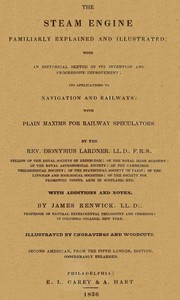
The Steam Engine Familiarly Explained and Illustrated: With an historical sketch of its invention and progressive improvement; its applications to navigation and railways; with plain axioms for railway speculators
Written by Dionysius Lardner
Chaptra reads alongside you — AI insights, chapter breakdowns and reader discussions for every book. Join free
About this book
Reading guide
Themes, characters and key ideas in The Steam Engine Familiarly Explained and Illustrated: With an historical sketch of its invention and progressive improvement; its applications to navigation and railways; with plain axioms for railway speculators, written by Chaptra AI.
- about 12 hours
- intermediate
- informative
- educational
- analytical
Dionysius Lardner's "The Steam Engine Familiarly Explained and Illustrated" is an early 19th-century scientific treatise designed to demystify steam power for a general audience. It meticulously traces the steam engine's invention and historical evolution, elucidating its fundamental mechanical principles, and showcasing its transformative applications, particularly in navigation and railways. Lardner emphasizes the steam engine's pivotal role in advancing human progress, aiming to make complex scientific concepts accessible. The work provides a foundational understanding of pressure, heat, and motion, underscoring human ingenuity's capacity to harness natural forces for technological advancement.
“The steam engine stands as a monument to human ingenuity, a force harnessed from nature to accelerate the march of civilization.”
Key themes
- Technological Innovation and Progress
- This theme explores the relentless advancement of technology, specifically the steam engine, as a driving force behind human progress. Lardner meticulously documents the historical improvements and future potentials, framing the steam engine as a symbol of humanity's capacity to overcome limitations and shape the physical world.
- Demystification of Science and Engineering
- A core objective of the book is to make complex scientific and mechanical principles accessible to a general audience. Lardner aims to 'familiarly explain' the steam engine, breaking down intricate concepts into understandable components and illustrating them clearly, thereby promoting scientific literacy.
- The Power of Human Ingenuity
- This theme celebrates the capacity of human intellect and creativity to observe natural phenomena, understand underlying principles, and apply that knowledge to create transformative tools and machines. The steam engine is presented as a prime example of human ingenuity harnessing natural forces for benefit.
Worth discussing
How does Lardner's approach to explaining complex machinery compare to modern popular science writing?
Chapter-by-chapter breakdowns, character arcs and the full thematic analysis come with a free account.
Discussions
No one has started one yet
Questions this book opens up
No discussions yet
Be the first to start a discussion about this book!
Sign up to start the discussionReviews
No reviews yet
Be the first to review this book!