
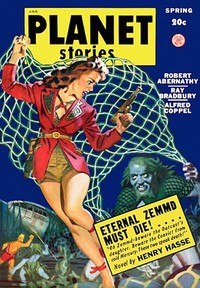
The Star Beast
Written by Damon Knight
Chaptra reads alongside you — AI insights, chapter breakdowns and reader discussions for every book. Join free
About this book
Reading guide
Themes, characters and key ideas in The Star Beast, written by Chaptra AI.
- about 8 hours
- intermediate
- mysterious
- thought-provoking
- tense
Damon Knight's "The Star Beast" is a mid-20th century science fiction novel that plunges into a thrilling murder mystery aboard the spaceship "President Marcus." Security agent Philip Horitz investigates the murder of Professor Thomasson, whose crucial faster-than-light travel equations are now missing. The only witness is Oscar, a tentacle-headed alien whose unique form of communication poses a significant challenge to human understanding. As Horitz navigates a complex web of suspects and rising tensions, the narrative skillfully explores profound themes of communication barriers, the nature of identity, and the ethical implications of advanced science, ultimately leading to a shocking revelation about intelligence and perception that blurs conventional definitions of friend and foe.
“"The greatest barrier between species is not language, but the very framework of perception."”
Key themes
- Communication and Misunderstanding
- The central theme revolves around the profound difficulty of communication, especially between radically different forms of intelligence. Oscar's non-human communication challenges human assumptions about language and expression, highlighting how our own perceptual frameworks limit our ability to understand 'the other.' The entire mystery hinges on the inability to interpret Oscar's 'testimony.'
- Identity and Consciousness
- The novel deeply explores what defines life, intelligence, and individual identity. Oscar, initially categorized as a 'beast,' forces humanity to reconsider its anthropocentric definitions of consciousness. The twist ending challenges the very nature of existence and how different beings perceive themselves and their reality.
- Truth vs. Perception
- This theme is epitomized by the novel's twist ending. What humans perceive as 'truth' – a murder, a victim, a perpetrator – is revealed to be radically different from Oscar's perception. The story challenges the reader to question the objectivity of their own reality and acknowledges that 'truth' can be subjective and multifaceted, especially when different forms of consciousness are involved.
Worth discussing
How does Knight use Oscar's alien nature to critique human anthropocentrism and prejudice?
Chapter-by-chapter breakdowns, character arcs and the full thematic analysis come with a free account.
Discussions
No one has started one yet
Questions this book opens up
No discussions yet
Be the first to start a discussion about this book!
Sign up to start the discussionReviews
No reviews yet
Be the first to review this book!