
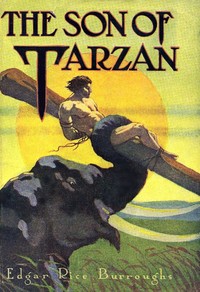
The Son of Tarzan
Written by Edgar Rice Burroughs
Chaptra reads alongside you — AI insights, chapter breakdowns and reader discussions for every book. Join free
About this book
Reading guide
Themes, characters and key ideas in The Son of Tarzan, written by Chaptra AI.
- about 8 hours
- intermediate
- adventure
- thrilling
- exotic
Edgar Rice Burroughs' "The Son of Tarzan" plunges readers into a thrilling adventure centered on Jack, the son of the legendary ape-man, Tarzan. Torn between a refined upbringing and an undeniable call to the wild, Jack embarks on a perilous journey that mirrors his father's, embracing his primal instincts as Korak, the Killer. His quest for identity and adventure intertwines with the malevolent schemes of Alexis Paulvitch, a recurring villain from Tarzan's past, leading to a dramatic clash between civilization's evils and the untamed jungle's raw justice. The narrative explores themes of heredity, environment, and the enduring legacy of a legendary figure, cementing the Tarzan mythos for a new generation.
“"He was Tarzan's son, and the call of the wild was in his blood."”
Key themes
- Nature vs. Nurture / Civilization vs. Wilderness
- This is the central thematic conflict, explored through Jack's upbringing and his eventual return to the jungle. The novel questions whether inherent instincts or learned behaviors ultimately define an individual, and whether the 'civilized' world is truly superior to the 'wild' in terms of morality and authenticity. Jack's struggle between his aristocratic identity and his primal urges highlights the tension between these two worlds.
- Identity and Legacy
- The novel deeply explores Jack's struggle to forge his own identity while living in the shadow of his famous father. It examines how a legendary legacy can both inspire and burden, and how one finds self-actualization by embracing or transcending that heritage. Jack's adoption of the name Korak signifies his creation of a unique identity.
- Good vs. Evil / Justice in the Wild
- The clear delineation between good and evil is a hallmark of Burroughs' writing. Paulvitch embodies pure, unadulterated evil, driven by revenge and cruelty, while Korak and Meriem represent innate goodness and a more primal, yet often fairer, form of justice. The jungle itself often serves as a moral arbiter, punishing wickedness and rewarding courage and loyalty.
Worth discussing
How does Jack's journey as Korak parallel, yet differ from, his father Tarzan's? What does this say about heredity versus environment?
Chapter-by-chapter breakdowns, character arcs and the full thematic analysis come with a free account.
Discussions
No one has started one yet
Questions this book opens up
No discussions yet
Be the first to start a discussion about this book!
Sign up to start the discussionReviews
No reviews yet
Be the first to review this book!