
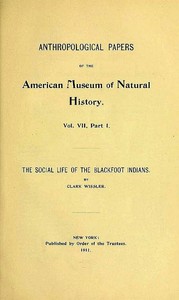
The Social Life of the Blackfoot Indians
Written by Clark Wissler
Chaptra reads alongside you — AI insights, chapter breakdowns and reader discussions for every book. Join free
About this book
Reading guide
Themes, characters and key ideas in The Social Life of the Blackfoot Indians, written by Chaptra AI.
- about 12 hours
- advanced
- informative
- academic
- observational
Clark Wissler's "The Social Life of the Blackfoot Indians" is a foundational early 20th-century anthropological examination of the Blackfoot Confederacy's social and cultural systems. Drawing on extensive fieldwork and collaboration with Indigenous informants, notably Mr. D. C. Duvall, the study meticulously details aspects such as tribal divisions, flexible band structures, marriage customs, and property rights. Wissler aims to provide a comprehensive understanding of how these Indigenous social structures functioned and adapted to various conditions. The work's introduction establishes the research framework and acknowledges the collaborative nature of data collection, setting the stage for an in-depth analysis of Blackfoot societal organization.
“Our aim is to present an in-depth understanding of the social structures and practices of this Indigenous group, based on data collected through fieldwork and collaboration.”
Key themes
- Social Organization and Structure
- This theme explores the intricate ways the Blackfoot people structured their society, including tribal divisions (Piegan, Blood, Northern Blackfoot) and the dynamic nature of their band system. It details how these structures facilitated community life, governance, and interaction.
- Cultural Adaptation and Resilience
- The study highlights how Blackfoot social systems, particularly the band structure, were not static but highly adaptable. This theme examines the mechanisms through which the community responded to changing sociological and economic conditions, demonstrating their resilience and capacity for dynamic adjustment.
- Ethnographic Methodology and Collaboration
- This theme focuses on Wissler's approach to anthropological research, emphasizing fieldwork and the crucial role of Indigenous informants. It reflects the early 20th-century development of ethnographic methods and the nascent recognition of Indigenous contributions to knowledge production.
Worth discussing
How does Wissler's methodology, particularly his collaboration with Mr. D. C. Duvall, reflect early 20th-century anthropological practices, and how might it be viewed through a contemporary lens?
Chapter-by-chapter breakdowns, character arcs and the full thematic analysis come with a free account.
Discussions
No one has started one yet
Questions this book opens up
No discussions yet
Be the first to start a discussion about this book!
Sign up to start the discussionReviews
No reviews yet
Be the first to review this book!