
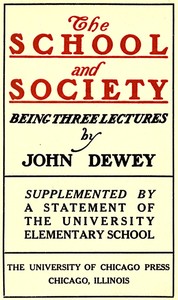
The School and Society: Being three lectures
Written by John Dewey
Chaptra reads alongside you — AI insights, chapter breakdowns and reader discussions for every book. Join free
About this book
Reading guide
Themes, characters and key ideas in The School and Society: Being three lectures, written by Chaptra AI.
- about 8 hours
- advanced
- Thought-provoking
- Philosophical
- Progressive
John Dewey's "The School and Society" critiques traditional education's detachment from societal needs, advocating for a progressive paradigm that views schools as vital instruments of social progress. The work champions a curriculum integrating practical skills and manual training, emphasizing experiential learning over rote memorization. Dewey posits the school as an 'embryonic community' where children actively engage in collaborative endeavors, fostering not only individual growth but also the collective development of society. He argues that education must evolve to reflect dynamic societal demands, preparing responsible citizens who contribute positively to their communities through a holistic, community-oriented process of learning.
“What the best and wisest parent wants for his own child, that must the community want for all of its children.”
Key themes
- Education as Social Progress and Reform
- Dewey fundamentally argues that education is not merely about individual enlightenment but is a primary instrument for social progress and reform. He critiques schools that are isolated from society's dynamic needs, asserting that education must actively engage with and adapt to the changing social, industrial, and democratic landscape. The school's purpose is to prepare citizens who can contribute to and improve society, making education a continuous process of social reconstruction.
- Child-Centered Learning and Experiential Education
- This theme emphasizes shifting the focus of education from the subject matter or the teacher to the child's natural interests, impulses, and experiences. Dewey advocates for learning through 'doing' – direct engagement with activities and problems – rather than passive reception of information. He identifies four key natural impulses (social, constructive, investigative, expressive) that should form the basis of the curriculum, ensuring that learning is meaningful, active, and rooted in the child's own experience.
- The School as a Democratic Community
- Dewey envisions the school as a miniature, simplified version of a democratic society. Within this 'embryonic community,' children learn not only academic subjects but also the essential habits of cooperation, shared responsibility, critical thinking, and respectful interaction necessary for democratic citizenship. The school's environment should foster active participation, problem-solving, and a sense of belonging, mirroring the ideals of a functioning democracy.
Worth discussing
How does Dewey's critique of traditional education in the late 19th century resonate with or differ from contemporary criticisms of schooling?
Chapter-by-chapter breakdowns, character arcs and the full thematic analysis come with a free account.
Discussions
No one has started one yet
Questions this book opens up
No discussions yet
Be the first to start a discussion about this book!
Sign up to start the discussionReviews
No reviews yet
Be the first to review this book!