
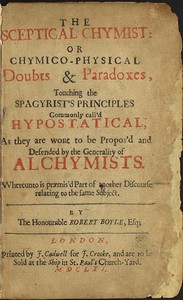
The Sceptical Chymist: or Chymico-Physical Doubts & Paradoxes, Touching the Spagyrist's Principles Commonly call'd Hypostatical; As they are wont to be Propos'd and Defended by the Generality of Alchymists. Whereunto is præmis'd Part of another Discourse relating to the same Subject.
Written by Robert Boyle
Chaptra reads alongside you — AI insights, chapter breakdowns and reader discussions for every book. Join free
About this book
Reading guide
Themes, characters and key ideas in The Sceptical Chymist: or Chymico-Physical Doubts & Paradoxes, Touching the Spagyrist's Principles Commonly call'd Hypostatical; As they are wont to be Propos'd and Defended by the Generality of Alchymists. Whereunto is præmis'd Part of another Discourse relating to the same Subject., written by Chaptra AI.
- about 20 hours
- advanced
- Analytical
- Philosophical
- Rigorous
Robert Boyle's "The Sceptical Chymist" is a seminal 17th-century scientific treatise that fundamentally challenges the prevailing chemical doctrines of Alchemists and Aristotelian Peripatetics. Presented as a philosophical dialogue, the work critiques the established theories of matter and elements, particularly the concepts of the three alchemical principles and the four Aristotelian elements. Boyle, through the character of Carneades, rigorously advocates for an empirical approach to understanding nature, emphasizing the necessity of experimental evidence over speculative dogma. This foundational text helped to redefine chemistry by proposing a more precise, operationally defined concept of a chemical element and laying groundwork for the modern scientific method.
“I discern not, why it should be a disparagement to a philosopher to have his theory confuted by experience, and forced to alter it by the light of new experiments.”
Key themes
- Empiricism and the Scientific Method
- This is the cornerstone of Boyle's argument. He rigorously advocates for knowledge derived from systematic observation and experimentation rather than reliance on ancient authority, speculative reasoning, or vague theoretical postulates. The entire book is a demonstration of how to apply an empirical lens to chemical inquiry, demanding verifiable evidence for all claims about the nature of matter.
- The Nature of Elements and Matter
- Boyle directly tackles the fundamental question of what constitutes the basic building blocks of the universe. He critiques the prevailing Aristotelian theory of four elements and the alchemical theory of three principles, demonstrating their inadequacy, ambiguity, and lack of experimental support. He proposes a revolutionary operational definition of an element as a substance that cannot be further decomposed by chemical means, thus laying the groundwork for modern chemistry's understanding of elements.
- Skepticism and Rational Inquiry
- Boyle, through Carneades, champions a philosophical skepticism that is not an end in itself, but a powerful tool for intellectual progress. He encourages readers to question established truths, challenge authority, and demand rigorous proof rather than passively accepting inherited doctrines. This theme is crucial to the broader Scientific Revolution, advocating for independent thought and critical evaluation.
Worth discussing
How does Boyle's definition of a chemical element differ from earlier conceptions, and what is its lasting impact?
Chapter-by-chapter breakdowns, character arcs and the full thematic analysis come with a free account.
Discussions
No one has started one yet
Questions this book opens up
No discussions yet
Be the first to start a discussion about this book!
Sign up to start the discussionReviews
No reviews yet
Be the first to review this book!