
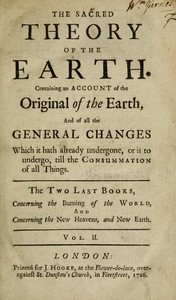
The sacred theory of the Earth, Volume 2 (of 2) : $b Containing an account of the original of the Earth, and of all the general changes which it hath already undergone, or is to undergo, till the consummation of all things.
Written by Thomas Burnet
Chaptra reads alongside you — AI insights, chapter breakdowns and reader discussions for every book. Join free
About this book
This work by Burnet, Thomas offers readers a unique literary experience. The narrative explores themes of earth (planet) and philosophy, ancient.
Reading guide
Themes, characters and key ideas in The sacred theory of the Earth, Volume 2 (of 2) : $b Containing an account of the original of the Earth, and of all the general changes which it hath already undergone, or is to undergo, till the consummation of all things., written by Chaptra AI.
- about 18 hours
- advanced
- speculative
- philosophical
- grand
Thomas Burnet's *The Sacred Theory of the Earth, Volume 2* continues his ambitious project to reconcile natural philosophy with biblical accounts of Earth's history. This volume delves into the Earth's primordial state, its transformation during the Universal Deluge, and its projected future changes leading to the final conflagration and renewal. Burnet employs a blend of geological speculation, classical philosophy, and scriptural interpretation to construct a grand, coherent narrative of the planet's past, present, and future, arguing for a rational, divinely ordained progression. It's a monumental work of 17th-century cosmological thought, profoundly influencing subsequent geological and theological discourse.
“The great Abyss was broken up, and the Fountains of the deep were opened.”
Key themes
- Divine Providence and Rational Design
- Burnet's central argument is that the Earth's history, from creation to its ultimate consummation, is not a series of arbitrary events but a divinely ordained, rational progression. He seeks to demonstrate God's wisdom and foresight through the natural mechanisms he proposes for the Earth's transformations, suggesting that even catastrophic events like the Deluge are part of a grand, logical plan. This theme reflects the Enlightenment's desire to find order and reason in the natural world, even within a theological framework.
- The History and Transformation of the Earth
- This is the most direct and explicit theme. Burnet presents a comprehensive, though speculative, history of the Earth, from its initial formation, through its major geological catastrophes (especially the Deluge), to its predicted future transformations and ultimate renewal. He is among the first to conceive of Earth having a deep and dynamic history, challenging the static view prevalent in much earlier thought. His focus on the Earth's physical changes establishes him as a precursor to modern geology.
- The Interplay of Reason and Revelation
- A cornerstone of Burnet's project is the attempt to harmonize biblical accounts (revelation) with the findings and methods of natural philosophy (reason). He interprets scripture not always literally but allegorically or in a way that allows for physical explanations. He uses reason to construct a plausible, mechanical theory for events like the Deluge, while simultaneously grounding these theories in the truth of the biblical narrative. This theme highlights the intellectual struggle of the 17th century to reconcile emerging scientific thought with established religious dogma.
Worth discussing
How does Burnet attempt to reconcile scientific reasoning with biblical accounts of creation and cataclysm? What are the strengths and weaknesses of his approach?
Chapter-by-chapter breakdowns, character arcs and the full thematic analysis come with a free account.
Discussions
No one has started one yet
Questions this book opens up
No discussions yet
Be the first to start a discussion about this book!
Sign up to start the discussionReviews
No reviews yet
Be the first to review this book!