
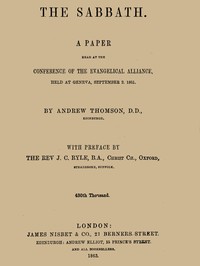
The Sabbath: A Paper Read at the Conference of the Evangelical Alliance, Held at Geneva, September 2. 1861
Written by Andrew Thomson
Chaptra reads alongside you — AI insights, chapter breakdowns and reader discussions for every book. Join free
About this book
Reading guide
Themes, characters and key ideas in The Sabbath: A Paper Read at the Conference of the Evangelical Alliance, Held at Geneva, September 2. 1861, written by Chaptra AI.
- about 2 hours
- advanced
- Serious
- Didactic
- Formal
Andrew Thomson's "The Sabbath," a theological paper presented in 1861, offers a fervent defense of traditional Sabbath observance within the Scottish Christian community. It posits the Sabbath as a divinely instituted day of rest and worship, crucial for the spiritual, moral, and social well-being of individuals and society. Thomson articulates the ideal Scottish practice, emphasizing complete dedication to religious activities, fostering spiritual joy, family worship, and communal bonding. The paper also critiques the growing threats of secular pursuits and amusements on the Sabbath, advocating for a return to its religious significance to uphold the moral fabric of Scottish society and reinforce Christian faith.
“The Sabbath is not merely a day of cessation from toil, but a divinely appointed institution, paramount for the spiritual, moral, and social well-being of man.”
Key themes
- Theological Significance of the Sabbath
- This is the central pillar of Thomson's paper, arguing that the Sabbath is not a mere human tradition but a divine institution, mandated by God and essential for humanity's spiritual well-being. He emphasizes its scriptural basis and its role as a covenant sign, providing a day for spiritual renewal and communion with the divine.
- Preservation of Religious Tradition and Observance
- Thomson passionately advocates for maintaining the traditional Scottish practices surrounding the Sabbath, which involve complete dedication to religious activities. This theme highlights the importance of inherited religious customs in shaping communal identity and individual piety, seeing them as vital for spiritual continuity.
- Threats of Secularism and Modernity
- This theme addresses Thomson's profound concern over the encroaching secularization of society, specifically manifested in the rise of secular amusements and leisure activities on the Sabbath. He views these as direct threats to the sacred nature of the day and, by extension, to Christian faith itself, undermining its authority and practice.
Worth discussing
How did the historical context of 19th-century Scotland and the Evangelical Alliance influence Thomson's arguments about the Sabbath?
Chapter-by-chapter breakdowns, character arcs and the full thematic analysis come with a free account.
Discussions
No one has started one yet
Questions this book opens up
No discussions yet
Be the first to start a discussion about this book!
Sign up to start the discussionReviews
No reviews yet
Be the first to review this book!