
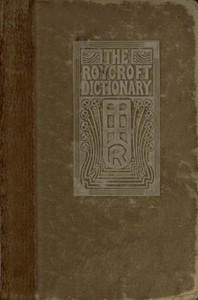
The Roycroft Dictionary, Concocted by Ali Baba and the Bunch on Rainy Days.
Written by Elbert Hubbard
Chaptra reads alongside you — AI insights, chapter breakdowns and reader discussions for every book. Join free
About this book
Reading guide
Themes, characters and key ideas in The Roycroft Dictionary, Concocted by Ali Baba and the Bunch on Rainy Days., written by Chaptra AI.
- about 6 hours
- intermediate
- humorous
- satirical
- witty
"The Roycroft Dictionary, Concocted by Ali Baba and the Bunch on Rainy Days" is a unique early 20th-century work by Elbert Hubbard, presenting a satirical take on traditional dictionary definitions. Through witty and often absurd interpretations of common words, the book offers a sharp critique of contemporary society, human foibles, politics, and conventional wisdom. It entertains readers with clever wordplay and unconventional meanings, inviting reflection on the absurdities of life and challenging established norms. The collection of humorous entries forms a cohesive social commentary, making it a distinctive piece of literary satire.
“ABEL: The first squealer.”
Key themes
- Critique of Conventional Wisdom
- Hubbard consistently challenges commonly accepted beliefs, moral platitudes, and traditional societal norms. He subverts expected definitions to expose the hypocrisy or superficiality embedded in conventional thought, encouraging readers to question ingrained ideas.
- Human Folly and Hypocrisy
- A recurring theme is the exposure of human vanity, self-deception, and the hypocritical nature of individuals and institutions. The dictionary frequently pokes fun at human weaknesses, self-importance, and the gap between stated ideals and actual behavior.
- Critique of Power and Institutions
- Hubbard directs significant satire towards political systems, legal structures, religious organizations, and other powerful societal institutions. He questions their legitimacy, efficiency, and often their moral standing, portraying them as flawed and frequently serving self-interest rather than the common good.
Worth discussing
How does Hubbard use the dictionary format to enhance his satirical critique, compared to a traditional narrative?
Chapter-by-chapter breakdowns, character arcs and the full thematic analysis come with a free account.
Discussions
No one has started one yet
Questions this book opens up
No discussions yet
Be the first to start a discussion about this book!
Sign up to start the discussionReviews
No reviews yet
Be the first to review this book!