
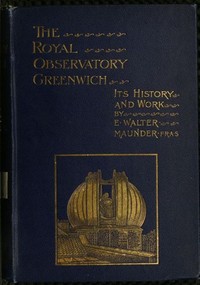
The Royal Observatory, Greenwich: A Glance at Its History and Work
Written by E. Walter (Edward Walter) Maunder
Chaptra reads alongside you — AI insights, chapter breakdowns and reader discussions for every book. Join free
About this book
Reading guide
Themes, characters and key ideas in The Royal Observatory, Greenwich: A Glance at Its History and Work, written by Chaptra AI.
- about 8 hours
- intermediate
- informative
- historical
- educational
E. Walter Maunder's "The Royal Observatory, Greenwich: A Glance at Its History and Work" offers a late 19th-century historical account of the Royal Observatory, Greenwich. The book elucidates the Observatory's foundational purpose, emphasizing its crucial role in practical navigation rather than merely celestial observation. Maunder addresses common public misconceptions about astronomical work, highlighting the dedicated scientific endeavors that often went unacknowledged. Through a chronological narrative, the text traces the institution's establishment, profiles pivotal figures like John Flamsteed, the first Astronomer Royal, and examines their significant contributions to astronomy and maritime navigation, underscoring the Observatory's lasting scientific and practical legacy.
“The Royal Observatory was established not for the gratification of mere curiosity, but for the practical advancement of navigation.”
Key themes
- Scientific Progress and Innovation
- This theme is central, detailing how the Observatory fostered continuous advancements in astronomical observation, instrumentation, and theoretical understanding. Maunder illustrates the iterative nature of science, where each generation builds upon the discoveries and methods of the last, leading to cumulative progress.
- The Importance of Navigation and Practical Application
- Maunder repeatedly emphasizes that the Observatory's primary raison d'être was to solve the practical problem of determining longitude at sea. This theme underscores how scientific endeavors, even those seemingly abstract, can have profound and direct impacts on commerce, exploration, and national security.
- Public Perception vs. Scientific Reality
- Maunder explicitly addresses the public's often romanticized or superficial understanding of astronomers and their work. He contrasts this with the arduous, meticulous, and sometimes tedious reality of scientific observation and data collection, advocating for a more informed appreciation of scientific labor.
Worth discussing
How does Maunder challenge common public perceptions of scientific work, and is this challenge still relevant today?
Chapter-by-chapter breakdowns, character arcs and the full thematic analysis come with a free account.
Discussions
No one has started one yet
Questions this book opens up
No discussions yet
Be the first to start a discussion about this book!
Sign up to start the discussionReviews
No reviews yet
Be the first to review this book!