
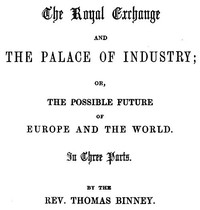
The Royal Exchange and the Palace of Industry; or, The Possible Future of Europe and the World
Written by Thomas Binney
Chaptra reads alongside you — AI insights, chapter breakdowns and reader discussions for every book. Join free
About this book
Reading guide
Themes, characters and key ideas in The Royal Exchange and the Palace of Industry; or, The Possible Future of Europe and the World, written by Chaptra AI.
- about 8 hours
- advanced
- reflective
- visionary
- didactic
Thomas Binney's mid-19th century religious treatise, "The Royal Exchange and the Palace of Industry," meticulously explores the profound connections between faith, commerce, and societal advancement. Prompted by the historical fire at the Royal Exchange, Binney uses this symbol of global trade to posit that all human enterprise and material wealth are ultimately God's, encapsulated by the scripture, "The Earth is the Lord’s, and the fulness thereof." He argues that acknowledging divine sovereignty and the moral responsibilities it entails is crucial for fostering global unity and cooperation. The work culminates in a prophetic vision that intertwines the forthcoming Great Exhibition with the potential for a more harmonious and divinely guided future for Europe and the world, advocating for a society built on shared spiritual truths and ethical commerce.
“The Royal Exchange, though consumed by flame, yet rises again, a testament to the enduring spirit of commerce and the divine hand that guides its course.”
Key themes
- Divine Sovereignty and Ownership
- This is the foundational theological principle of Binney's work. He argues that God is the ultimate owner of the earth and all its resources, including human labor and commercial endeavors. This theme underpins his call for moral responsibility, asserting that human activity, especially commerce, must align with divine will and purpose. It challenges the purely secular or materialist view of wealth and progress, embedding them within a sacred framework.
- The Interplay of Faith and Commerce
- Binney actively seeks to bridge the perceived divide between spiritual life and economic activity. He argues that commerce, far from being a purely secular pursuit, can and should be a vehicle for divine purpose and a catalyst for moral and social progress. He advocates for an integration where business practices are guided by Christian ethics, leading to a more just and harmonious society.
- Global Unity and Cooperation
- Binney envisions a future where nations move beyond conflict and competition towards a state of shared harmony and cooperation, all under the overarching sovereignty of God. He sees the Royal Exchange, with its international traders, and especially the Great Exhibition, as precursors to this unified global society, suggesting that shared faith and moral principles can transcend nationalistic divisions.
Worth discussing
How does Binney's interpretation of the Royal Exchange fire set the tone for his broader argument, and what symbolic weight does he attribute to it?
Chapter-by-chapter breakdowns, character arcs and the full thematic analysis come with a free account.
Discussions
No one has started one yet
Questions this book opens up
No discussions yet
Be the first to start a discussion about this book!
Sign up to start the discussionReviews
No reviews yet
Be the first to review this book!