
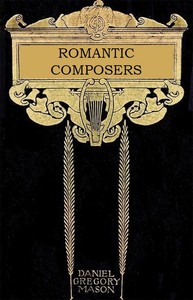
The Romantic Composers
Written by Daniel Gregory Mason
Chaptra reads alongside you — AI insights, chapter breakdowns and reader discussions for every book. Join free
About this book
Reading guide
Themes, characters and key ideas in The Romantic Composers, written by Chaptra AI.
- about 10 hours
- intermediate
- informative
- analytical
- historical
Daniel Gregory Mason's "The Romantic Composers" offers a foundational study of the Romantic Period in music, penned in the early 20th century. The book meticulously traces the evolution of musical Romanticism, beginning with an insightful introduction to its core tenets as a departure from classical traditions. Mason then embarks on a detailed examination of pivotal composers such as Schubert, Schumann, Mendelssohn, Chopin, Berlioz, and Liszt, dissecting their unique contributions and stylistic innovations. The analysis emphasizes the profound connection between each composer's personal character and their artistic output, illustrating how individual expression and emotional depth became central to this transformative era. Ultimately, Mason's work illuminates the philosophical underpinnings and the redefinition of musical language that characterized Romanticism.
“The Romantic spirit in music marked a profound shift, placing individual expression and emotional depth at the forefront, a stark departure from the structured impersonality of classicism.”
Key themes
- Individual Expression in Music
- This theme explores how Romantic composers moved away from classical objectivity, infusing their music with personal feelings, experiences, and subjective perspectives. Mason argues that this emphasis on individuality was the defining characteristic of the era, leading to a richer, more emotionally resonant musical language.
- The Influence of Personal Character on Art
- Mason meticulously examines how the unique personality, life experiences, and psychological makeup of each composer directly shaped their musical output. This theme suggests a direct, causal link between the artist's inner world and the external manifestation of their art.
- Evolution of Musical Language
- This theme focuses on the technical and structural innovations that Romantic composers introduced to convey new emotional and dramatic content. It covers developments in harmony (e.g., chromaticism), melody (e.g., lyricism, expansive phrases), rhythm, form (e.g., symphonic poem), and orchestration (e.g., expanded instrument ranges, new sonorities).
Worth discussing
How does Mason define 'Romanticism' in music, and how does this definition resonate with or differ from your own understanding of the period?
Chapter-by-chapter breakdowns, character arcs and the full thematic analysis come with a free account.
Discussions
No one has started one yet
Questions this book opens up
No discussions yet
Be the first to start a discussion about this book!
Sign up to start the discussionReviews
No reviews yet
Be the first to review this book!