
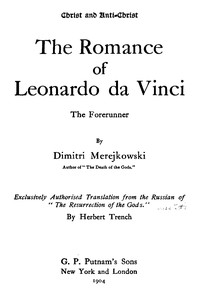
The Romance of Leonardo da Vinci, the Forerunner
Written by Dmitry Sergeyevich Merezhkovsky
Chaptra reads alongside you — AI insights, chapter breakdowns and reader discussions for every book. Join free
About this book
Reading guide
Themes, characters and key ideas in The Romance of Leonardo da Vinci, the Forerunner, written by Chaptra AI.
- about 25 hours
- advanced
- philosophical
- historical
- introspective
Dmitry Merezhkovsky's "The Romance of Leonardo da Vinci, the Forerunner" is an ambitious historical novel that vividly resurrects the life and intellectual struggles of the Renaissance polymath. Set against the tumultuous backdrop of late 15th-century Italy, the narrative explores Leonardo's relentless pursuit of knowledge, art, and scientific truth amidst a society torn between ancient paganism, burgeoning humanism, and rigid Christian orthodoxy. Through the eyes of his apprentice, Giovanni Boltraffio, and other contemporaries, the novel delves into the philosophical dilemmas of the era, portraying Leonardo as a solitary genius whose foresight often clashes with the dogmatic forces of his time. It is a profound exploration of the nature of genius, the conflict between faith and reason, and the enduring quest for beauty and understanding that defines the human spirit.
“The world is full of wonders, but man sees them not, for he is blind to all but his own dogma.”
Key themes
- The Conflict of Art, Science, and Religion
- This is the central theme, exploring the fundamental tension between empirical observation and artistic creation (embodied by Leonardo) and dogmatic religious faith (represented by Savonarola). The novel delves into how these forces clash, compromise, and sometimes intertwine in the Renaissance, questioning where true knowledge and spiritual fulfillment lie.
- The Nature and Burden of Genius
- The novel deeply explores what it means to be a genius like Leonardo – the boundless curiosity, the innovative thinking, and the isolation that often accompanies such a mind. It portrays how Leonardo's advanced intellect and foresight set him apart from, and often in conflict with, his contemporaries, making him a 'forerunner' who is frequently misunderstood.
- Humanism vs. Dogma
- This theme examines the ideological battle between the burgeoning humanistic values of the Renaissance, which celebrated human potential, classical learning, and individual reason, and the rigid dogmatism of the Church, which emphasized divine authority, sin, and salvation. The novel positions Leonardo and figures like Cipriano as proponents of humanism against the anti-intellectual fervor of Savonarola.
Worth discussing
How does Merezhkovsky portray the tension between scientific inquiry, artistic expression, and religious dogma in the Renaissance? Is this conflict still relevant today?
Chapter-by-chapter breakdowns, character arcs and the full thematic analysis come with a free account.
Discussions
No one has started one yet
Questions this book opens up
No discussions yet
Be the first to start a discussion about this book!
Sign up to start the discussionReviews
No reviews yet
Be the first to review this book!