
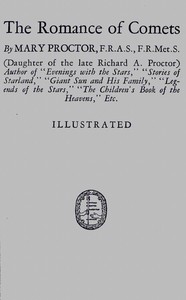
The romance of comets
Written by Mary Proctor
Chaptra reads alongside you — AI insights, chapter breakdowns and reader discussions for every book. Join free
About this book
Reading guide
Themes, characters and key ideas in The romance of comets, written by Chaptra AI.
- about 8 hours
- intermediate
- mysterious
- informative
- historical
“The Romance of Comets” by Mary Proctor, an early 20th-century scientific publication, masterfully blends astronomical facts with rich historical and cultural narratives. The book traces humanity's journey from viewing comets as terrifying omens to understanding them through scientific inquiry, highlighting pivotal shifts in perception. Proctor uses engaging prose and historical anecdotes to demystify these celestial visitors while preserving their inherent allure and mystery. It serves as both an informative scientific text and a captivating historical account, emphasizing the collaborative efforts of astronomers like E. E. Barnard in advancing comet research. Ultimately, the work invites readers to appreciate the profound intersection of science, history, and human wonder in the study of the cosmos.
“For ages, comets were not merely celestial visitors, but potent omens, casting shadows of fear and prophecy across the human imagination.”
Key themes
- The Evolution of Scientific Understanding
- This theme traces humanity's intellectual journey from a state of fear and superstition regarding celestial phenomena to one of rational inquiry and scientific comprehension. Proctor meticulously details how observations, calculations, and the development of scientific methodologies gradually replaced folkloric interpretations and omens. It highlights the triumph of reason and empirical evidence in shaping our view of the cosmos.
- The Enduring Mystery and Allure of the Cosmos
- Despite the advancements in scientific understanding, Proctor emphasizes that comets, and the cosmos at large, retain an inherent sense of wonder, beauty, and mystery. She captures the 'romance' and 'allure' of these celestial visitors, suggesting that even with scientific explanation, the profound beauty and vastness of the universe continue to inspire awe and curiosity.
- The Collaborative Nature of Scientific Discovery
- Proctor highlights that scientific progress is rarely the work of a single individual but rather a cumulative effort built upon the observations, theories, and calculations of many. She explicitly acknowledges the contributions of various astronomers, underscoring the importance of shared knowledge and collective endeavor in advancing human understanding of the universe.
Worth discussing
How does 'The Romance of Comets' illustrate the evolution of scientific thought from ancient superstition to modern understanding?
Chapter-by-chapter breakdowns, character arcs and the full thematic analysis come with a free account.
Discussions
No one has started one yet
Questions this book opens up
No discussions yet
Be the first to start a discussion about this book!
Sign up to start the discussionReviews
No reviews yet
Be the first to review this book!