
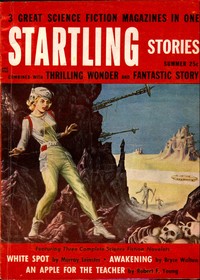
The rogue waveform
Written by R. W. (Ralph Walter) Stockheker
Chaptra reads alongside you — AI insights, chapter breakdowns and reader discussions for every book. Join free
About this book
Read it with a club
Chaptra's fiction clubs — small groups reading the same books and talking as they go.


CraxMe Readers Book Club
Fiction
- 385 members
- 227 discussions
- Started December 2025
Welcome to the Readers Book Club. This is an informal group for like-minded people, where you can discuss books, share and recommend, track your reading progress, and lots more. Discuss Books — all about books. Discuss a particular book or genre, share your favourite quotes. Book Reviews — loved a book and highly recommend it? Or was it just average? Share your review and discuss with fellow readers. (May contain spoilers.) Group Reads — what is a book club without a group read! Buddy Reads — planning to read a book and looking for someone to read it with? Post in the Buddy Read request thread, find a reading buddy, and start discussing.
Read The rogue waveform alongside people who are reading it too.
Also here: Doorstops, First Lines Club
Chaptra Prime — paid clubs, every club feature, and unlimited reading support, for $5 a month or $60 once.
See PrimeReading guide
Themes, characters and key ideas in The rogue waveform, written by Chaptra AI.
- about 8 hours
- intermediate
- humorous
- quirky
- transformative
R. W. Stockheker's 1955 science fiction novel, "The Rogue Waveform," delves into the bizarre transformation of Freddy Booten, a reviled professional wrestler known as Don Diablo. His life takes an extraordinary turn when scientist Panda offers to analyze and modify his unique "rogue symbiotic waveform." Through a controversial bio-electronic procedure, Freddy is unexpectedly changed from a universally detested figure into one who is inexplicably lovable, affecting everyone from his wrestling fans to his own farm animals. The novel humorously explores the consequences of scientific intervention on identity, human nature, and societal perception, as Freddy grapples with his new, overwhelming popularity and the implications of his altered self.
“"Don Diablo was not just a villain; he was an institution of loathing, a monument to public disdain."”
Key themes
- Identity and Transformation
- The central theme revolves around the radical alteration of Freddy's identity. The novel explores what constitutes 'self' when personality can be scientifically modified, and the struggle of an individual to reconcile a past, detested self with a new, universally loved persona. It questions whether inherent identity can truly be changed or merely masked.
- Scientific Ethics and Intervention
- The novel directly addresses the ethical implications of scientific research, particularly when it intervenes with fundamental aspects of human personality. Panda's 'controversial procedure' raises questions about the responsibility of scientists, the unforeseen consequences of experiments, and whether it is morally permissible to alter an individual's core nature, even if the outcome seems 'positive.'
- Perception vs. Reality
- The novel humorously highlights the disparity between how an individual perceives themselves and how they are perceived by others. Freddy's transformation dramatically alters public perception, forcing him to confront a reality where he is adored despite feeling like the same person (or a confusingly different one). It satirizes the superficiality of public opinion and the power of charisma.
Worth discussing
How does 'The Rogue Waveform' use humor to explore serious themes of identity and human nature?
Chapter-by-chapter breakdowns, character arcs and the full thematic analysis come with a free account.
Discussions
No one has started one yet
Questions this book opens up
No discussions yet
Be the first to start a discussion about this book!
Sign up to start the discussionReviews
No reviews yet
Be the first to review this book!