
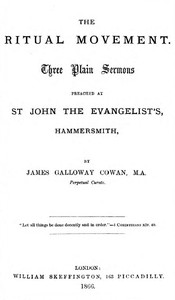
The Ritual Movement: Three plain sermons preached at St. John the Evangelist's, Hammersmith
Written by James Galloway Cowan
Chaptra reads alongside you — AI insights, chapter breakdowns and reader discussions for every book. Join free
About this book
Reading guide
Themes, characters and key ideas in The Ritual Movement: Three plain sermons preached at St. John the Evangelist's, Hammersmith, written by Chaptra AI.
- about 8 hours
- advanced
- theological
- persuasive
- reverent
James Galloway Cowan's "The Ritual Movement" compiles three mid-19th century Anglican sermons advocating for a balanced approach to church ritualism. Cowan argues that worship necessitates both spiritual engagement and physical expression through ritual, drawing on historical Christian practice and divine prescription for order and decency. He explores the theological underpinnings of ritual, emphasizing its role in elevating devotion and honoring God, while navigating the complexities introduced by the Reformation. The work ultimately promotes unity and decorum in worship, cautioning against excessive ritualism that could devolve into formalism or idolatry, urging instead a harmonious integration of faith's internal and external dimensions.
“"True worship is not merely an internal sentiment, but must find its proper, reverent expression through the body, in ritualistic acts designed to elevate and honor God."”
Key themes
- The Importance of Ritual in Worship
- This is the central theme, exploring how ritual is not merely superficial but a fundamental, divinely sanctioned aspect of worship that engages the whole person (body and spirit) and contributes to order, reverence, and the honoring of God. Cowan argues that ritual provides a necessary structure for spiritual expression.
- Historical Continuity and Tradition
- Cowan grounds his arguments in the historical lineage of Christian practice, asserting that the importance of ritual is not a new innovation but a continuous tradition dating back to the early Church and even divine command. He uses history to validate and legitimize current practices.
- Balance and Moderation in Faith
- A crucial aspect of Cowan's argument is the call for a balanced approach to ritualism, steering clear of extremes. He champions a middle ground that respects tradition and external expression without descending into empty formalism or idolatry, while also avoiding the spiritual sterility of entirely neglecting ritual.
Worth discussing
How does Cowan define 'ritualism' and how does his definition compare to contemporary understandings of ritual in religious or secular contexts?
Chapter-by-chapter breakdowns, character arcs and the full thematic analysis come with a free account.
Discussions
No one has started one yet
Questions this book opens up
No discussions yet
Be the first to start a discussion about this book!
Sign up to start the discussionReviews
No reviews yet
Be the first to review this book!