
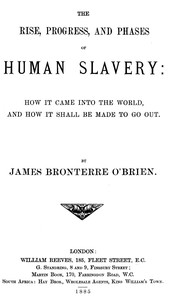
The rise, progress, and phases of human slavery: How it came into the world and how it shall be made to go out
Written by James Bronterre O'Brien
Chaptra reads alongside you — AI insights, chapter breakdowns and reader discussions for every book. Join free
About this book
Reading guide
Themes, characters and key ideas in The rise, progress, and phases of human slavery: How it came into the world and how it shall be made to go out, written by Chaptra AI.
- about 12 hours
- advanced
- analytical
- critical
- polemical
James Bronterre O'Brien's "The Rise, Progress, and Phases of Human Slavery" is a profound late 19th-century historical and polemical work that meticulously traces the evolution of human slavery from its ancient origins to its contemporary manifestations. O'Brien argues that slavery is a universal and persistent phenomenon, not limited to overt chattel slavery but subtly ingrained in societal structures, even in so-called civilized nations. He critically introduces the concept of "Proletarianism," positing that the working classes of his era are effectively modern slaves, trapped in a cycle of exploitation fostered by historical economic systems and insufficient reforms. The book serves as an urgent call for radical social reform, aiming to dismantle these entrenched forms of servitude and achieve true emancipation for all.
“Slavery, in one form or another, has been the universal lot of man in every age and every clime.”
Key themes
- Universality and Evolution of Slavery
- This theme is central to O'Brien's argument, positing that slavery is not an isolated historical phenomenon but a persistent human condition that merely changes its form. He traces its evolution from ancient patriarchal power to chattel slavery, serfdom, and ultimately to the modern 'Proletarianism,' arguing that the underlying mechanism of one group's exploitation by another remains constant.
- Critique of Capitalism and 'Proletarianism'
- O'Brien fundamentally critiques the economic system of his time, arguing that industrial capitalism, despite its promises of freedom, effectively enslaves the working classes. He coins 'Proletarianism' to describe the condition of workers who, lacking ownership of the means of production, are compelled to sell their labor for wages that barely sustain them, thus perpetuating a cycle of exploitation akin to historical slavery.
- Social Reform and Emancipation
- The book is ultimately a fervent call for radical social reform. O'Brien argues that true emancipation requires more than superficial legal changes; it demands a fundamental restructuring of society to eliminate the root causes of exploitation and inequality. He seeks to identify not just how slavery came into the world, but crucially, how it shall be made to go out, implying a need for collective action and systemic change.
Worth discussing
How does O'Brien's definition of 'slavery' challenge or expand your conventional understanding of the term?
Chapter-by-chapter breakdowns, character arcs and the full thematic analysis come with a free account.
Discussions
No one has started one yet
Questions this book opens up
No discussions yet
Be the first to start a discussion about this book!
Sign up to start the discussionReviews
No reviews yet
Be the first to review this book!