
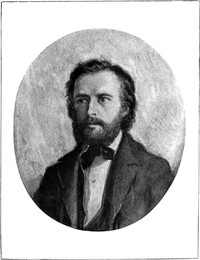
The Riddle of the Universe at the close of the nineteenth century
Written by Ernst Haeckel
Chaptra reads alongside you — AI insights, chapter breakdowns and reader discussions for every book. Join free
About this book
Reading guide
Themes, characters and key ideas in The Riddle of the Universe at the close of the nineteenth century, written by Chaptra AI.
- about 12 hours
- advanced
- philosophical
- scientific
- didactic
Ernst Haeckel's "The Riddle of the Universe" is a seminal late 19th-century scientific and philosophical treatise that attempts to resolve humanity's fundamental existential questions through a monistic worldview. It posits that the universe, life, and consciousness are unified under immutable natural laws, rejecting dualism and supernatural explanations. The book critiques contemporary societal and spiritual stagnation, proposing that scientific advancement, particularly in biology and evolution, holds the key to understanding the profound "world-riddles" of existence. Through empirical investigation and a confident, often polemical style, Haeckel champions a rational, materialist interpretation of reality, advocating for a unified understanding of nature and human experience.
“The great 'riddle of the universe' has been solved by science.”
Key themes
- Monism vs. Dualism
- The central philosophical conflict of the book. Haeckel rigorously argues for monism—the idea that reality is ultimately one unified substance, rejecting any form of dualism (e.g., mind/body, spirit/matter, God/creation). He posits that matter and energy are inseparable, and all phenomena, including consciousness, are manifestations of this single substance governed by natural laws.
- Science vs. Religion/Dogma
- Haeckel positions science as the ultimate arbiter of truth, directly challenging and often vehemently dismissing religious dogma, traditional metaphysics, and clerical authority. He argues that scientific empirical investigation provides the only valid path to understanding the universe, while religion represents superstition and intellectual stagnation.
- Evolution and Natural Law
- Darwinian evolution is a foundational pillar of Haeckel's monistic worldview. He uses evolutionary theory, alongside embryology and comparative anatomy, to demonstrate the common ancestry of all life forms, including humans, and to explain the development of complex organisms through natural processes. This theme underscores the universal applicability of natural laws across all domains of existence.
Worth discussing
How does Haeckel's monistic philosophy compare with contemporary scientific and philosophical views on the relationship between mind and matter?
Chapter-by-chapter breakdowns, character arcs and the full thematic analysis come with a free account.
Discussions
No one has started one yet
Questions this book opens up
No discussions yet
Be the first to start a discussion about this book!
Sign up to start the discussionReviews
No reviews yet
Be the first to review this book!